
A potential customer visits your website. They are interested, but they are not ready to buy. Another customer sees a campaign and wants more information, while someone else has already asked about a product but has not returned. A fourth customer is ready to speak to sales right now. These people should not all receive the same message because they are at different stages of the buying journey.
That is where a WhatsApp lead funnel becomes useful. Instead of treating WhatsApp as a place to send occasional promotions, businesses can use it as part of a structured journey that helps people move from interest to conversation, from conversation to qualification, and from qualification toward purchase.
WhatsApp can support several stages of this journey. Chatbots can answer initial questions, automated flows can gather useful information, marketing campaigns can nurture leads, and interactive messages can reduce friction. Sales teams can continue conversations through a shared inbox, while leads that do not convert immediately can be re-engaged later when appropriate.
Javna supports this type of customer journey across WhatsApp and other communication channels. Its marketing solution explicitly includes lead nurturing through WhatsApp and SMS flows, while its AI chatbot platform can respond to prospects, qualify leads, and guide them through marketing funnels. The objective is not simply to generate more messages. It is to build a better path from interest to conversation, qualification, follow-up, conversion, and retention.
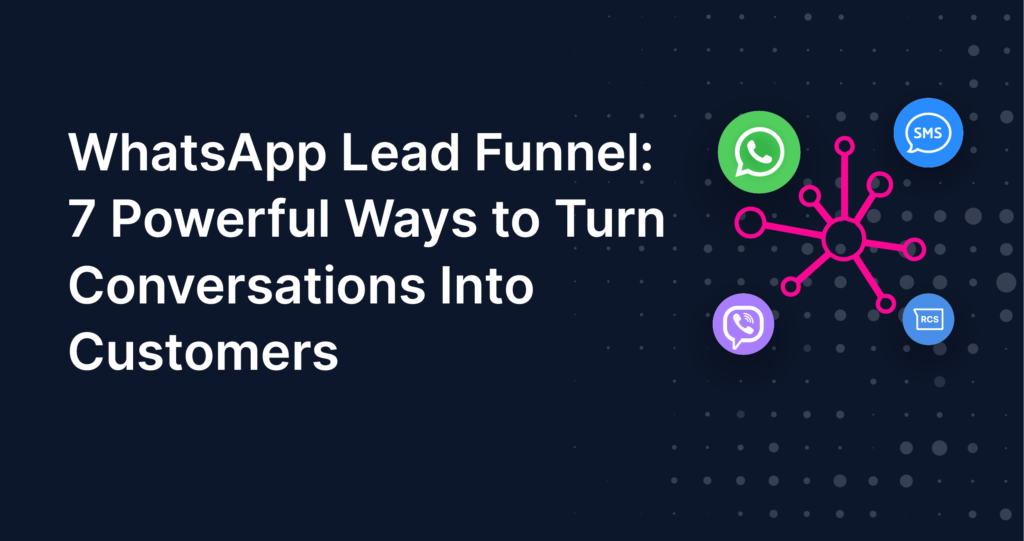
WhatsApp Lead Funnel
A WhatsApp lead funnel is a structured customer journey that uses WhatsApp to help potential customers move toward a business goal. That goal may be buying a product, requesting a quotation, booking a consultation, registering for a service, speaking with a salesperson, or completing another conversion action.
Traditional funnels often move people between different environments. A customer sees an ad, visits a website, fills out a form, receives an email, and waits for a salesperson to call later. Every transition creates another chance for the lead to disappear. WhatsApp can make parts of that journey more conversational by allowing potential customers to move from interest to a direct business conversation, ask questions, and share relevant details with a chatbot. The business can then provide information or have a sales representative take over where necessary.
Javna’s WhatsApp Business Platform supports automated conversations, lead qualification, interactive messaging, marketing campaigns, and a Unified Team Inbox for sales, marketing, and support conversations. That makes WhatsApp useful across more than one funnel stage: it can help attract a conversation, qualify interest, nurture the relationship, support conversion, and continue supporting the customer after the sale.
Why WhatsApp Works Across the Lead Funnel
Lead funnels often fail because communication becomes disconnected. Marketing generates a lead, sales receives it later, and the customer has to explain everything again. Follow-ups may arrive without context, questions can go unanswered, and the lead may lose interest before someone responds.
WhatsApp can create a more continuous journey because communication happens in a familiar conversational environment. Javna’s marketing platform is designed to automate customer communication from first engagement through post-purchase retention, including promotional campaigns, lead nurturing, customer retention, product launches, surveys, and abandoned-cart recovery.
The key advantage is continuity. A lead may first receive a campaign message and then respond. A chatbot may answer a routine question, and if the customer shows stronger buying intent, the conversation can move toward a salesperson. If the customer does not convert, an appropriate follow-up may happen later. The relationship does not need to restart at every stage, creating a funnel built around conversation rather than isolated touchpoints.
How a WhatsApp Lead Funnel Works
A strong WhatsApp funnel usually begins with an entry point. That may come from a website, marketing campaign, QR code, social channel, existing contact list, or another business touchpoint. Once the person starts engaging, the business needs to understand what they want. That is where automation and qualification become useful.
A simple funnel may look like this:
Interest → WhatsApp conversation → Question or qualification flow → Relevant information → Sales conversation → Purchase or next action → Follow-up
The exact journey will depend on the business. A retailer has a different funnel from a university, just as a bank has a different funnel from a travel company. The technology should support the journey rather than force every business into the same structure.
Capture Interest Through Conversation
Lead generation starts with reducing friction. If a potential customer wants information, they should have a clear way to begin the conversation. Javna supports WhatsApp Business messaging alongside web chat and other customer-engagement channels. Its marketing solution also describes web chat and AI bots as tools that can convert website traffic into leads through conversational marketing experiences.
The first conversation does not need to be complex. A prospect may simply ask how much a product costs, whether it is available, whether someone can contact them, which package is right for them, or how to book. The first objective is not to force a sale; it is to understand the customer’s intent. Once that intent becomes clearer, the funnel can move forward.
Qualify Leads Automatically
Not every lead has the same level of interest. Some are ready to buy, some are comparing options, some need basic information, and others may not be a fit. Lead qualification helps businesses identify these differences so they can determine the most appropriate next step.
Javna explicitly supports AI chatbots that can qualify leads and guide customers through marketing funnels 24/7. Its chatbot platform can also be built without coding and used across WhatsApp, web, and social messaging channels. A qualification flow might ask what product the customer is interested in, what service they need, their preferred location, when they need it, and whether they would like to speak with sales.
The questions should be relevant to the business. Too many questions create friction, while too few may leave the sales team without enough context. The goal is to collect enough information to determine the right next step.
Move Qualified Leads Toward Sales
Automation should not trap qualified customers inside a chatbot. When someone demonstrates clear buying intent, a human salesperson may be the best next step. Javna’s Unified Inbox supports sales, marketing, and support teams in managing WhatsApp conversations through a shared environment. It includes conversation assignment, customer context, conversation history, internal collaboration, and handover between automation and human agents.
This creates an important transition:
Bot identifies intent → Lead becomes qualified → Conversation reaches sales → Salesperson continues with context
The customer should not need to start again. A good handover preserves continuity, which is one of the biggest differences between disconnected lead capture and conversational lead management.
7 Ways to Improve Your Lead Funnel With WhatsApp
A WhatsApp funnel should not simply send more messages. Every step should remove friction or add useful information. These seven approaches can help businesses design a stronger journey.
Turn Website Visitors Into Conversations
Many websites receive visitors who never fill out a form. A visitor may have a question but not want to submit a long contact form and wait for a reply. Conversational entry points create another option by giving visitors a direct way to ask questions and explore what the business offers.
Javna supports web chat and chatbot experiences designed to engage website visitors and convert traffic into leads. It also supports WhatsApp as part of the same wider customer-engagement environment. A visitor could begin with a simple question, automation could answer immediately, and the conversation could continue into a lead journey when appropriate.
The key is making the transition easy. Do not ask for ten pieces of information before providing any value. Give the customer a reason to continue.
Use Chatbots to Qualify Leads 24/7
Lead interest does not always arrive during office hours. A customer might research a product at midnight, while another may contact the business on a weekend. Without automation, that interest can sit unanswered.
Javna’s chatbot platform can respond around the clock, handle FAQs, qualify leads, and guide prospects through marketing funnels. This does not mean the chatbot should pretend to be a salesperson in every situation. Its strongest role is often to handle predictable stages, such as identifying the request, collecting useful information, answering standard questions, suggesting the appropriate next step, and routing stronger opportunities to people.
This allows sales teams to spend more time on conversations where human input creates value.
Segment Leads for More Relevant Follow-Ups
A lead who asked about Product A should not automatically receive the same follow-up as someone interested in Product B. Similarly, a customer who is ready for a quote should not receive the same message as someone who downloaded basic information yesterday. Segmentation helps solve this problem by making communication more relevant to each lead’s interests and stage.
Javna’s marketing capabilities include audience segmentation and targeted messaging based on customer behavior, location, and engagement. Campaigns can then be delivered through channels including WhatsApp and SMS.
Useful lead segments might include:
| Lead segment | Possible next communication |
| New inquiry | Helpful introduction or answer |
| Product-specific interest | Relevant product information |
| Qualified lead | Sales follow-up |
| High-intent lead | Direct sales conversation |
| Event lead | Event-related nurturing |
| Inactive lead | Re-engagement message |
| Cart abandoner | Personalized cart reminder |
The exact segmentation model depends on the organization, but the principle is universal: more context should lead to more relevant communication.
Nurture Leads With Automated WhatsApp Messages
Not every prospect converts during the first conversation. Lead nurturing keeps the relationship active without forcing the customer to make an immediate decision. Javna explicitly supports lead nurturing through WhatsApp or SMS flows that can follow up with leads, share product updates, and communicate limited-time offers.
A nurturing sequence could provide useful product information, answers to common questions, a relevant reminder, an event invitation, an appropriate offer, or a prompt to speak with sales. The content should match the lead’s needs and the stage they have reached.
Timing matters. Sending five messages in a short period does not make the lead five times more likely to buy; it can have the opposite effect. Lead nurturing should be helpful rather than aggressive. The business should also follow applicable consent and messaging rules when initiating WhatsApp conversations.
Use Interactive Messages to Reduce Friction
Every extra step can reduce conversion. If a customer has to type a long response, search through a website, or guess what to do next, some will leave the journey. Interactive WhatsApp experiences can simplify decisions by allowing customers to choose from clear options rather than composing every response themselves.
Javna’s WhatsApp API supports interactive message formats including lists, reply buttons, call-to-action URL buttons, WhatsApp Flow Messages, catalogs, and product messages. For example, instead of asking a customer to explain which service they are interested in, a business might present structured choices. The customer selects an option, and the workflow continues based on that response.
WhatsApp Flows can also support more structured interactions where an eligible use case benefits from collecting information inside a guided experience. The goal should always be less friction. Interactive tools are useful when they simplify the journey, not when they add unnecessary steps.
Connect Sales Teams Through a Unified Inbox
Lead nurturing becomes difficult when conversations are scattered across personal devices and unrelated inboxes. A prospect may speak to marketing first, then sales, and later support. If each team sees only part of the history, the customer experience becomes repetitive.
Javna’s Unified Inbox centralizes WhatsApp, Instagram, Messenger, and web chat conversations and is designed for collaboration across support, sales, and operational teams. It includes conversation assignments, internal notes, tags, history, customer context, and human handover.
For a lead funnel, this means a salesperson can receive a conversation with more context, understand what happened before the handover, and continue rather than restart. That is especially valuable for qualified leads.
Re-Engage Leads That Did Not Convert
A lead that does not buy today is not necessarily lost forever. They may need more time, have become distracted, or be waiting for a better moment to make a decision. The product may be right, but the purchase may simply have been postponed.
Javna supports automated re-engagement campaigns for inactive customers and leads, along with lead nurturing and personalized campaign workflows. For e-commerce journeys, Javna also supports abandoned-cart recovery through automated WhatsApp reminders containing personalized product links.
Re-engagement should still be relevant. A useful message reminds the person why they showed interest, while a poor message simply repeats, “Buy now. Buy now. Buy now.” Good lead funnels respect timing.
Building a WhatsApp Lead Nurturing Strategy
Technology works best when the funnel is designed first. Businesses should map their lead stages before building automation so that each message, workflow, and handover has a clear purpose.
Define Lead Stages First
A simple model might include new lead, engaged lead, qualified lead, sales-ready lead, converted customer, and inactive or unconverted lead. Different businesses may use different definitions, and that is fine. The important thing is that teams agree on what each stage means.
For example, when does someone become qualified? Is it after answering specific questions, requesting pricing, speaking with a chatbot, or requesting a sales call? Clear definitions help automation and sales teams work together and reduce confusion about which leads are ready for human follow-up.
Match Messages to Customer Intent
Once stages are defined, map communication to them. A new lead may need education, a qualified lead may need pricing or human assistance, and an inactive lead may need a gentle follow-up. A customer who has already bought should move into post-purchase communication rather than continuing to receive lead-conversion messages.
A simple model looks like this:
| Funnel stage | Customer need | WhatsApp role |
| Awareness | Understand the business | Start conversation |
| Interest | Get information | FAQs and interactive content |
| Qualification | Find the right fit | Chatbot questions |
| Consideration | Build confidence | Personalized follow-up |
| High intent | Take action | Sales handover |
| Conversion | Complete next step | Guided communication |
| Post-purchase | Stay informed | Updates and support |
| Retention | Remain engaged | Relevant re-engagement |
This keeps the funnel focused on customer intent instead of sending generic messages at every stage.
Know When Automation Should Hand Over
A chatbot can help scale lead management, but it cannot replace every sales conversation. Some customers want detailed pricing, some need negotiation, some have unusual requirements, and others simply ask to speak with someone.
Javna’s Unified Inbox supports handover between automation and human agents and provides conversation context to teams handling those interactions. Businesses should define clear handover triggers, such as when a customer requests a salesperson, a high-value opportunity is identified, the bot cannot answer, the product requirement is complex, or the customer repeatedly expresses confusion.
Automation should make it easier to reach the right person, not harder.
Connect WhatsApp With Your Existing Systems
Lead funnels become more useful when WhatsApp does not operate in isolation. A business may already use a CRM, e-commerce platform, CMS, or another internal environment. Javna’s marketing platform supports API and system integration to automate triggers and synchronize audience data, while its developer APIs support sending and receiving WhatsApp messages programmatically.
Inbound WhatsApp messages can also be delivered to configured systems through webhooks in real time. Conceptually, the process can follow this path:
Customer action → WhatsApp conversation → Javna workflow → Business system or CRM, where configured → Qualification or sales action
This can help businesses reduce disconnected manual processes. Javna remains the communication and engagement layer rather than replacing every system the business already uses.
Measure and Improve Funnel Performance
A funnel should be measured by more than the number of messages sent. Businesses should look at where leads move forward and where they disappear. Useful questions include how many conversations become qualified leads, which campaigns generate meaningful replies, how quickly sales responds after handover, where customers stop chatbot flows, which audience segments respond best, and how many qualified leads ultimately convert.
Javna’s WhatsApp Business Platform provides real-time analytics and reporting for messaging and campaign performance, while its marketing tools support campaign analytics and engagement measurement. The business can combine this information with its own sales or CRM data to measure the full funnel.
The optimization cycle becomes:
Attract → Engage → Qualify → Nurture → Convert → Measure → Improve
WhatsApp Lead Funnel Across the Customer Journey
A lead funnel should not stop the moment a customer purchases. The relationship changes, but communication continues. Before conversion, WhatsApp can help answer questions and nurture interest. During conversion, it can support the customer with interactive communication and sales assistance. After conversion, the same communication environment can provide order updates, customer support, feedback requests, and re-engagement.
Javna positions its customer-engagement capabilities across marketing, sales, and customer support from a unified platform. Its WhatsApp Business offering specifically supports all three teams from one communication environment. This creates a broader journey:
Lead generation → Lead qualification → Lead nurturing → Sales → Customer support → Retention
A strong funnel therefore does more than create a customer. It creates continuity after conversion.
How Javna Supports WhatsApp Lead Generation and Nurturing
Javna brings together the main capabilities needed to create a WhatsApp lead funnel. For lead nurturing, businesses can use WhatsApp or SMS flows to follow up with prospects, share product information, and deliver relevant offers. For lead qualification, Javna’s chatbot platform can respond instantly, qualify leads, personalize interactions, and guide prospects through marketing funnels across WhatsApp, web, and supported social channels.
For campaigns, Javna supports WhatsApp broadcasts using templates and recipient groups, alongside broader segmentation and campaign scheduling capabilities. For interactive journeys, the Javna WhatsApp API supports reply buttons, lists, CTA URL buttons, Flow Messages, catalogs, single-product messages, and multi-product messages.
For sales collaboration, the Unified Inbox centralizes conversations and allows teams to assign chats, maintain context, collaborate, and hand conversations from automation to human employees. For system connectivity, Javna provides APIs and webhooks that can connect customer communication with CRM, CMS, e-commerce, and other business environments where configured. For prospects who do not convert immediately, Javna supports re-engagement and abandoned-cart recovery workflows.
The resulting model can be simple:
Generate interest → Start WhatsApp conversation → Qualify with automation → Personalize follow-up → Transfer qualified opportunities to sales → Continue nurturing where needed → Support customers after conversion
Javna provides the communication tools. The business defines the funnel.
Frequently Asked Questions
What is a WhatsApp lead funnel?
A WhatsApp lead funnel is a structured customer journey that uses WhatsApp to capture interest, answer questions, qualify prospects, nurture leads, support sales conversations, and continue communication after conversion.
Can Javna use WhatsApp for lead nurturing?
Yes. Javna explicitly supports lead nurturing through WhatsApp and SMS flows for following up with leads, sharing product updates, and sending relevant offers that help move prospects toward purchase.
Can Javna qualify leads automatically?
Yes. Javna’s AI Chatbot Platform is designed to respond to prospects, qualify leads, and guide customers through marketing funnels 24/7.
Can a chatbot hand a qualified lead to a salesperson?
Yes. Javna’s Unified Inbox supports handover between automation and human agents, along with conversation assignment, history, tags, internal notes, and customer context.
Can businesses segment WhatsApp leads with Javna?
Javna’s marketing tools support audience segmentation and targeted communication based on factors such as behavior, location, and engagement. Businesses can then use those segments in relevant campaign and nurturing strategies.
Does Javna support interactive WhatsApp lead forms or flows?
Javna’s WhatsApp API supports WhatsApp Flow Messages as well as interactive lists, reply buttons, and CTA URL buttons. These formats can be used in appropriate workflows to create more structured customer interactions.
Can Javna integrate WhatsApp with a CRM?
Javna’s marketing offering supports API integrations with CRM, CMS, and e-commerce environments to automate triggers and synchronize audience data. The exact integration architecture depends on the systems used by the business.
Can Javna re-engage leads that did not convert?
Yes. Javna supports automated re-engagement campaigns and lead-nurturing workflows. For e-commerce, it also supports abandoned-cart reminders with personalized product links.
Can businesses run WhatsApp campaigns with Javna?
Yes. Javna supports WhatsApp campaigns using approved message templates and recipient groups, alongside campaign scheduling, segmentation, and analytics capabilities.
Does WhatsApp replace the sales team?
No. WhatsApp automation can handle repetitive questions, qualification, follow-ups, and routing, but qualified or complex opportunities can be handed to human sales teams through Javna’s Unified Inbox.
Conclusion
A strong lead funnel is not built by sending more messages. It is built by making each interaction move the customer closer to the right next step. Someone who has only just discovered your business needs information, while someone comparing products needs answers. Someone showing serious interest may need qualification, a qualified prospect may need a salesperson, and someone who does not convert may need a relevant follow-up later.
That is where a WhatsApp lead funnel can become powerful. WhatsApp turns the lead journey into a conversation, while Javna adds the tools needed to structure that conversation through campaigns, lead-nurturing flows, chatbots, segmentation, interactive messaging, WhatsApp Flows, APIs, automation, analytics, and a Unified Inbox for human teams.
The best approach is not to automate every customer interaction; it is to automate the predictable parts. Use customer context to make follow-ups more relevant, give prospects simple ways to move forward, recognize buying intent, and bring a salesperson into the conversation when it matters. Continue supporting the customer after conversion, and the funnel becomes less like a series of disconnected marketing steps and more like one connected customer journey.
Start the conversation. Understand the intent. Nurture the opportunity. Make the next step easy.
Key Takeaways About the WhatsApp Lead Funnel
- Use WhatsApp across the funnel: It can support lead capture, qualification, nurturing, sales conversations, post-purchase communication, and re-engagement.
- Qualify before selling: Javna chatbots can help identify intent and qualify leads before conversations reach sales teams.
- Make nurturing relevant: Audience segmentation and automated WhatsApp flows help businesses follow up based on customer context instead of sending the same message to everyone.
- Reduce friction with interaction: Buttons, lists, CTA messages, WhatsApp Flows, catalogs, and other supported interactive formats can make lead journeys easier to navigate.
- Combine automation with people: Javna’s Unified Inbox enables qualified or complex opportunities to move from automation to human sales teams while maintaining conversation context.
- Use Javna as the engagement layer: Campaigns, chatbots, WhatsApp APIs, webhooks, segmentation, integrations, analytics, and conversation management can connect the full WhatsApp lead funnel without requiring Javna to replace the business’s CRM or sales systems.