
Marketing has spent years becoming faster, more targeted, and more automated. Businesses can now reach thousands of customers in seconds, segment audiences, schedule campaigns, and measure engagement almost immediately.
Yet there is still a problem.
Marketing communication is often one-way. A customer sees an ad, receives a message, visits a landing page, or opens a promotional campaign. But what happens when that customer has a question? What if they are interested but do not know which product is right for them? What if they want to speak with sales, compare options, or simply understand what to do next?
This is where AI chatbots in marketing are changing the customer journey. Instead of making customers move through static pages and forms, AI-powered conversational experiences can allow them to ask questions, explain their needs, discover products, provide information, qualify themselves as potential leads, and move toward the next relevant action.
For marketers, this creates a major opportunity. A chatbot can provide immediate engagement without requiring a human employee to manually handle every first interaction. At the same time, automation does not need to replace people. When a conversation becomes more valuable, complex, or unusual, it can move toward a human team.
Javna’s AI Chatbot Building Platform supports marketing, sales, lead generation, customer support, FAQs, feedback, product discovery, and other conversational use cases. Its chatbots can operate across WhatsApp, Webchat, Messenger, and Instagram, while its broader platform supports human handoff and centralized conversation management. The future of marketing, then, is not simply about sending more messages. It is about creating better conversations.
AI Chatbots in Marketing
AI chatbots in marketing are conversational systems that help businesses interact with prospects and customers throughout different stages of the marketing journey. Traditional chatbots were often built around rigid menus and predefined responses. They could be useful when the customer’s question matched an expected path, but the experience could quickly become frustrating when someone asked something differently.
AI-powered chatbots can make these experiences more flexible by helping interpret customer intent and respond using configured information and conversational logic. Javna, for example, documents natural language processing as part of its chatbot platform, alongside knowledge-base capabilities that allow businesses to provide FAQs and documents as information sources.
For marketers, the important difference is that the chatbot can become involved in several stages of the customer journey rather than performing only one task. A marketing chatbot might help:
- Welcome visitors arriving from a campaign.
- Answer common product or service questions.
- Capture customer information.
- Qualify potential leads.
- Recommend relevant products.
- Guide customers toward a suitable next action.
- Collect feedback after an interaction.
- Move complex conversations to a human employee.
Javna provides specialized chatbot use cases for many of these scenarios, including Marketing Chatbots, Sales Chatbots, Lead Generation Bots, FAQ and Knowledge Bots, Customer Support Chatbots, and Feedback and Survey Bots. This makes the chatbot less like a digital answering machine and more like an interactive layer between marketing campaigns and the people responding to them.
The technology, however, should not become the strategy. A business still needs to determine what the chatbot should achieve, what information it can use, which questions it should ask, and when a human should become involved.
From Rule-Based Bots to AI-Powered Conversations
The evolution of chatbots is important because it explains why they are becoming more relevant to marketers. Early chatbots depended heavily on rules. A customer clicked an option or used a specific phrase, and the system returned a predefined response. These systems could work well for simple tasks, but they offered limited flexibility when customers moved outside the expected path. AI-powered conversational systems can create more natural interactions by interpreting language and customer intent within their configured scope.
Javna’s chatbot platform combines a no-code visual builder with AI-driven understanding. Businesses can design flows visually, use natural language processing to interpret messages, and provide knowledge through FAQs and documents. Consider a simple example. A traditional flow might ask:
What do you need?
- Product information
- Sales
- Support
- Other
A more conversational experience can allow the customer to type:
“I’m looking for something suitable for my online store.”
The chatbot can use that input to guide the next part of the conversation rather than requiring the customer to understand the company’s internal menu structure. This can make digital marketing feel less mechanical.
But AI does not remove the need for structure. Businesses still need to establish reliable knowledge, clear conversation goals, escalation rules, and appropriate boundaries. The strongest conversational experience combines the flexibility of AI with the control of a well-designed customer journey.
Where AI Chatbots Fit in the Customer Journey
AI chatbots can support customers at several points in the marketing journey, from the first interaction to post-purchase engagement. Their role changes according to what the customer is trying to achieve.
A new visitor may need a quick answer before exploring further. A potential lead may need help identifying the right product or service. A qualified prospect may be ready to speak with sales, while an existing customer may return with a question or need further assistance.
Rather than creating a separate chatbot for every stage, businesses can design conversational journeys that respond to customer intent and guide people toward the most useful next step.
| Customer stage | Common need | Chatbot role |
| Discovery | Understand the offer | Answer initial questions |
| Engagement | Explore products or services | Start a relevant conversation |
| Lead generation | Express interest | Capture useful information |
| Consideration | Compare options | Support product discovery |
| Conversion | Move forward | Qualify intent or connect with sales |
| Existing customer | Continue the relationship | Support, feedback, or re-engagement |
Javna’s chatbot capabilities can support these types of interactions across marketing, sales, lead generation, product discovery, and customer support. The important point is not to force every customer through the same funnel. The conversation should adapt to the purpose of the interaction. The practical ways businesses can apply this approach become clearer in the following strategies.
7 Powerful Ways AI Chatbots Are Changing Marketing
The strongest case for AI chatbots comes from practical use cases. Rather than asking whether AI will “change everything,” marketers should identify the customer interactions where conversation can actually improve the experience.
Engage Customers 24/7
Customers browse when it suits them, not when it suits the marketing department. Someone may arrive from a campaign late at night. Another visitor may research products during the weekend. A prospect may have a question while the sales team is handling other conversations. Without automation, those moments can end with a form and a promise that someone will respond later. A chatbot can begin the interaction immediately.
Javna’s marketing solution describes its AI chatbots as capable of responding instantly, qualifying leads, and guiding customers through marketing funnels 24/7. Its Webchat also supports automated assistance when teams are offline. During that initial interaction, the chatbot might answer a common question, collect lead information, identify what the visitor needs, recommend a next step, or prepare the conversation for human follow-up. The benefit is not that humans become unnecessary. It is that customers do not always have to wait for the conversation to begin.
Qualify Leads Through Conversation
Lead generation and lead qualification are different jobs. A campaign can generate hundreds of contacts, but sales teams still need to understand which prospects deserve attention and what those prospects actually want. Conversational qualification can help bridge this gap. Instead of asking every prospect the same long list of questions, the chatbot can collect relevant information during the interaction.
Depending on the business, useful qualification information may include:
- Product or service interest
- Customer or company type
- Market or location
- Business requirement
- Expected timeline
- Preferred next action
Javna’s Lead Generation Bot supports collecting customer information and qualifying prospects, while its marketing and sales solutions also include AI-assisted lead qualification.
The business should still define what “qualified” means. For one company, company size may matter. For another, product interest may be enough. For another, the most important signal may simply be that the customer explicitly asks to speak with sales. AI supports the conversation. The organization defines the business logic behind it.
Create More Personalized Customer Journeys
Good personalization is not about repeatedly using someone’s first name. It is about relevance. A customer interested in one product category should not be forced through information about five unrelated categories. Someone asking for support should not receive the same conversation as a new sales prospect. A visitor who has already provided information should not need to repeat it unnecessarily.
Javna’s marketing platform supports personalized interactions and audience segmentation, while its chatbot platform supports personalized conversational experiences and product recommendations. Marketers can use these capabilities to create different conversational paths around customer needs.
For example, an e-commerce chatbot might ask what type of product the shopper wants and then guide them toward relevant choices. A B2B chatbot might determine the customer’s business requirement before suggesting the appropriate next step. Personalization should always serve the customer. If it makes the journey faster and more useful, it adds value. If it simply demonstrates how much customer data the business has collected, it can have the opposite effect.
Make Product Discovery Easier
Finding the right product can be difficult when customers face too many choices. Search bars and category filters help, but they require customers to know what they are looking for. Conversation provides another option. A shopper can explain the problem they want to solve or describe what they need. The chatbot can then use the available product information and configured journey to guide the customer toward relevant options.
Javna explicitly supports product recommendations through its AI chatbot platform. Its Webchat AI Sales Assistant can also recommend products, qualify leads, and guide visitors toward purchase decisions. Consider an online retailer with a large catalog.
Instead of expecting every visitor to understand every product difference, the chatbot might ask about:
Product type
- Intended use
- Preferences
- Relevant requirements
- Other decision-making criteria
The resulting conversation can narrow the available choices. The chatbot becomes a discovery layer, while the e-commerce platform remains the environment where the underlying catalog and purchase journey operate.
Extend Conversations Across Customer Channels
Customers move between channels naturally. They may discover a brand on Instagram, visit its website, and later continue the conversation through WhatsApp. From the customer’s point of view, these are not necessarily separate marketing strategies. They are simply different ways of communicating with the same business. That makes omnichannel chatbot deployment increasingly useful.
Javna’s no-code AI chatbot platform supports chatbot experiences across WhatsApp, Webchat, Messenger, and Instagram. This can help businesses bring conversational automation into the places where customers already interact. The goal is not necessarily to create an identical bot on every channel. A website conversation may have a different context from a WhatsApp conversation. What matters is consistency.
Customers should receive reliable information, recognize the brand experience, and have a clear path forward regardless of where the conversation begins.
Combine AI Automation With Human Teams
One of the most useful ways to think about chatbot marketing is not AI versus humans, but AI plus humans. Automation is good at handling repeated interactions. It can answer common questions, collect information, guide predictable journeys, and help identify customer intent. People are better suited to conversations that require judgment, creativity, negotiation, empathy, or unusual problem solving.
Javna’s chatbot platform explicitly supports Human + AI Collaboration, allowing automation to handle repetitive interactions while teams focus on higher-value conversations. Its Unified Inbox adds human handoff, conversation history, customer context, assignments, and team collaboration. This creates a more practical division of work.
| AI chatbot can help with | Human teams can focus on |
| Common questions | Complex requirements |
| Initial engagement | Negotiation |
| Lead information collection | High-value opportunities |
| Basic qualification | Unusual situations |
| Product discovery | Relationship building |
| Routine guidance | Decisions requiring judgment |
This model is often more useful than trying to automate every possible customer conversation.
Turn Conversations Into Marketing Insights
Customers tell businesses what matters to them every day.
- They ask the same questions.
- They struggle with the same product information.
- They become confused at particular stages.
- They request human help at certain moments.
- They show interest in specific topics.
- A chatbot can make some of these patterns easier to observe.
Javna’s chatbot platform provides analytics for monitoring performance, tracking conversation flows, and optimizing responses. Its Webchat also provides performance insights covering areas such as chat volume, response time, satisfaction, and conversion-related performance. Suppose many prospects ask about pricing before they provide lead information. That could suggest pricing information needs to be clearer earlier in the journey.
- If customers repeatedly leave at one chatbot question, perhaps the question is unnecessary or difficult.
- If a particular topic frequently requires human handoff, the marketing team can decide whether to improve the automated content or deliberately route that topic to people sooner.
Conversation data should not simply create another dashboard. It should help marketers ask better questions about the customer experience.
Multilingual AI Chatbots for MENA Marketing
For businesses operating across the Middle East, multilingual customer engagement is not a minor feature. It can be central to the experience. Arabic and English are widely used across business and consumer interactions, and companies may need to engage different customer groups through the language that feels most natural to them.
Javna’s no-code multilingual AI chatbot builder provides native Arabic and English support, including right-to-left experiences for Arabic. The same chatbot environment supports deployment across WhatsApp, Instagram, Messenger, and Webchat. This gives marketers an important foundation for regional conversational journeys. However, multilingual marketing involves more than translating words.
Teams should consider how the complete experience works in each language, including:
- Tone of voice
- Product terminology
- Calls to action
- Button labels
- Right-to-left presentation
- Brand language
- Customer expectations
An English campaign translated word for word into Arabic may be technically understandable without sounding natural. he better approach is to design the conversation for the audience. For MENA marketers, that makes multilingual chatbot strategy part of customer experience design rather than simply a translation task.
How to Build an AI Chatbot Marketing Strategy
Successful chatbot marketing begins before the chatbot is built. Businesses first need to identify the customer problem they want to solve. Maybe marketing generates leads but sales lacks context. Perhaps website visitors struggle to find products. Maybe campaign traffic arrives outside working hours. Or the same pre-sales questions consume large amounts of employee time. Once the problem is clear, teams can design a focused conversational experience around it.
Start With a Clear Marketing Goal
- “Use AI” is not a marketing objective.
- “Qualify more website leads before sales follow-up” is.
- “Help shoppers discover suitable products” is.
- “Answer common questions from campaign traffic immediately” is.
A clear objective determines what the chatbot needs to do and what success should look like.
For example:
Goal: Improve lead qualification
Chatbot role: Ask relevant questions and capture intent
Human role: Handle qualified opportunities
Measurement: Qualified leads and downstream outcomes
Or:
Goal: Improve product discovery
Chatbot role: Understand customer needs and recommend relevant products
Human role: Assist with complex questions
Measurement: Product engagement and relevant conversion outcomes
Javna provides different chatbot use cases for marketing, sales, lead generation, customer support, FAQs, feedback, and product discovery, allowing businesses to align the conversational experience with a specific objective.
Design the Conversation Around Customer Intent
A chatbot should feel useful from the customer’s first interaction. That means marketers need to think beyond the questions the business wants answered. They also need to consider what the customer wants.
- If a visitor asks about pricing, answer the pricing question before forcing them through a long qualification sequence.
- If someone wants product information, help them find it.
- If a qualified prospect wants a salesperson, make that next step clear.
Javna’s no-code chatbot builder allows businesses to create conversational flows visually, while its AI and knowledge-base capabilities can support responses based on configured information.
A useful conversation usually follows a simple principle:
Understand → Help → Qualify when relevant → Guide → Escalate when necessary
That is more customer-friendly than turning every chatbot into a digital questionnaire.
Connect the Chatbot With Business Systems
Conversation becomes more useful when it connects with the rest of the customer journey. A qualified prospect may need to enter a CRM. Customer information may need to be available to sales. A chatbot conversation may need to trigger or support another business workflow.
Javna provides APIs and integration capabilities for connecting its communication platform with applications, CRMs, and other systems. Its Webchat also supports lead capture and CRM synchronization. The exact architecture depends on the organization’s existing technology.
Javna should therefore be viewed as the conversational customer-engagement layer in this context, not as a replacement for every CRM, e-commerce, or business system.
Define When Human Handoff Should Happen
Human handoff should not be an emergency exit added after launch. It should be designed into the customer journey.
Businesses can define situations where a person becomes more appropriate, such as when:
- The customer explicitly asks for a human.
- A qualified prospect wants to speak with sales.
- The question falls outside the chatbot’s configured knowledge.
- The conversation involves a complex requirement.
- A high-value opportunity needs personal attention.
- Automation is not successfully resolving the interaction.
Javna’s Unified Inbox supports seamless handover between automation and human agents while maintaining conversation history and customer context. That context is important.
The ideal experience is not:
Bot fails → Customer starts again with a person.
It is:
Bot gathers context → Human receives conversation → Human continues from where automation stopped.
Measure, Learn, and Improve
A chatbot should not remain unchanged after launch. Customer behavior will reveal where the journey works and where it needs improvement.
Javna’s chatbot platform provides analytics for monitoring performance and conversation flows, while Webchat includes additional visibility into customer interactions and performance.
Teams can review questions such as:
- Which conversation paths are used most?
- Where do customers leave?
- Which questions appear repeatedly?
- How often is human handoff needed?
- Are leads reaching the intended next step?
- Which chatbot journeys need clearer information?
The exact metrics should depend on the original marketing goal.
A lead-generation chatbot should ultimately be evaluated on lead-related outcomes, not simply message volume. A product-discovery chatbot should be evaluated on whether it helps customers navigate toward relevant products. Good analytics connect conversation activity with customer outcomes.
AI Chatbots vs Traditional Marketing Automation
AI chatbots and traditional marketing automation should not be treated as competitors. They perform different jobs. Traditional automation works well when the business already knows what should happen. A customer enters a segment, an event occurs, or a scheduled time arrives, and the system delivers a predefined communication. Conversational automation becomes useful when the customer’s response affects what happens next.
| Area | Traditional Automation | AI Chatbots |
| Communication style | Often one-way | Two-way conversation |
| Customer input | Usually limited | Central to the interaction |
| Best suited for | Scheduled and triggered messaging | Interactive journeys |
| Lead capture | Often form-based | Conversational |
| Product discovery | Usually link/content based | Guided conversation |
| Questions | Requires another interaction | Can answer supported questions |
| Human transition | May happen separately | Can be designed into the journey |
| Optimization | Campaign metrics | Conversation + journey analytics |
The two approaches can work together. A marketing campaign may attract a customer. The customer opens a conversational experience. The chatbot answers questions and collects relevant information. When buying intent becomes clear, a human salesperson can continue.
Javna supports campaign automation alongside AI chatbot experiences, helping businesses combine outbound marketing communication with interactive customer engagement. Common AI Chatbot Marketing Mistakes The excitement around AI can encourage businesses to automate before they understand what customers actually need.
One common mistake is trying to make the chatbot handle everything. A focused chatbot that performs several useful tasks reliably can provide a better experience than a complicated bot attempting to cover every possible conversation. Another problem is excessive qualification. Marketers naturally want more customer data, but asking ten questions before providing any value can make the chatbot feel like a longer version of a form. Businesses should also avoid making human assistance difficult to reach. If the customer clearly needs a person, additional automated loops create friction rather than efficiency.
Other mistakes worth watching include:
- Using outdated product or service information.
- Creating different and inconsistent answers across channels.
- Asking customers for information that is not needed.
- Building conversations around internal departments instead of customer intent.
- Measuring message volume instead of meaningful outcomes.
- Launching the chatbot and never reviewing its performance.
There is also an important expectation problem.
AI chatbots should not be described as independent marketing strategists if that is not what the technology is doing. Automation can interpret supported intent, use configured knowledge, guide conversations, and execute designed workflows. Marketing strategy still belongs to the business.
Responsible AI Chatbot Marketing
Better automation should also mean more responsible automation. Customer conversations may contain names, contact details, preferences, interests, and other information. Businesses need to understand what information they collect, why they need it, how it will be used, and what rules apply to their organization and market.
The safest principle is simple: do not collect data merely because the chatbot can ask for it. Accuracy also matters. Knowledge sources should be maintained. Chatbot responses should be reviewed. Businesses should monitor where automation struggles and provide a practical path toward human assistance.
Marketing teams should also think about transparency. Customers should not be manipulated into believing automation is a human employee when that distinction matters to the interaction.
Responsible AI chatbot marketing therefore combines several ideas:
Useful automation + relevant data + maintained knowledge + clear boundaries + human oversight Trust is not a separate feature added after the chatbot is built. It is part of the customer experience.
How Javna Supports AI Chatbot Marketing
Javna brings several of these capabilities together through its AI-powered customer-engagement platform. Its No-Code AI Chatbot Building Platform allows business teams to visually create conversational experiences for marketing, sales, lead generation, support, FAQs, feedback, and other customer journeys. The platform includes AI-driven language understanding, knowledge-base capabilities, multilingual support, human collaboration, and analytics.
For marketers specifically, Javna supports AI chatbots that can respond to prospects, qualify leads, personalize interactions, and guide customers through marketing funnels. Its broader marketing capabilities also include campaign scheduling, audience segmentation, automation, and analytics.
Javna also supports several important parts of the conversational marketing journey:
- Lead generation and qualification: collect customer information and help identify relevant prospects.
- Product discovery: recommend products and support pre-purchase conversations through chatbot and Webchat experiences.
- Multilingual engagement: build Arabic and English chatbot experiences, including RTL support for Arabic.
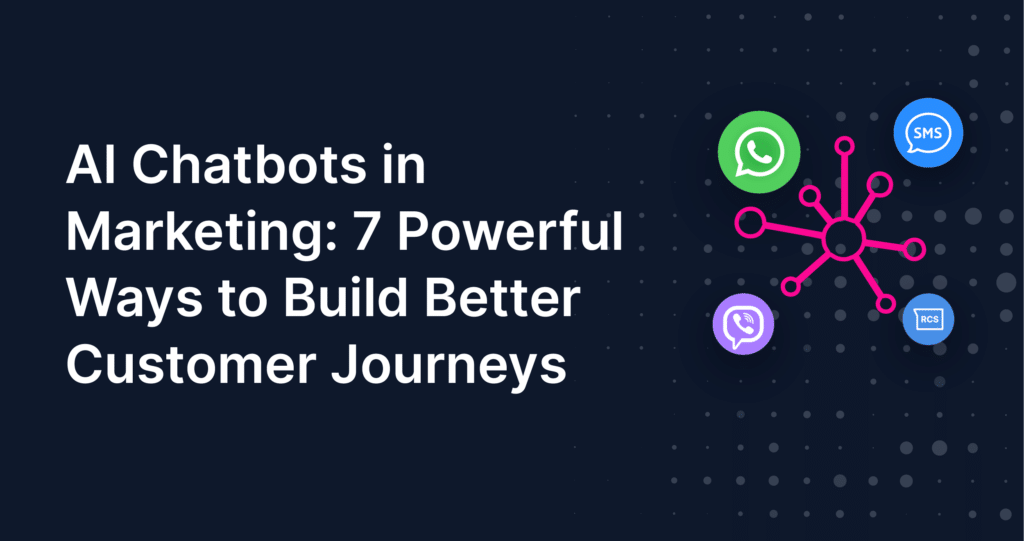
- Multiple customer channels: deploy chatbot experiences across WhatsApp, Instagram, Messenger, and Webchat.
- Human handoff: transfer conversations from automation to human teams when needed.
- Unified conversation management: bring WhatsApp, Instagram, Messenger, and Webchat conversations into the Unified Inbox.
- Analytics and optimization: monitor chatbot performance and conversation flows to identify opportunities for improvement.
Together, these capabilities create a practical marketing workflow:
Campaign or website visit → Customer starts conversation → AI chatbot identifies intent → Relevant information or product guidance → Lead qualification when appropriate → Human handoff when needed → Analytics inform future improvement
Javna provides the conversational engagement layer behind this journey. The business remains responsible for its marketing strategy, qualification criteria, product information, offers, customer-data policies, and decisions requiring human judgment. This distinction is important because successful AI marketing does not come from handing control of marketing to a machine. It comes from using automation where it creates genuine customer value. Businesses interested in building these experiences can explore the Javna AI Chatbot Building Platform.
Frequently Asked Questions
What are AI chatbots in marketing?
AI chatbots in marketing are conversational tools that help businesses interact with prospects and customers through automated digital conversations. They can support activities such as answering questions, collecting lead information, qualifying prospects, recommending products, gathering feedback, and guiding customers toward relevant next steps.
How can AI chatbots improve lead generation?
AI chatbots can turn lead capture into a conversation rather than relying only on static forms. They can collect contact information while also asking relevant questions about customer intent, needs, or interests. This can give sales teams more useful context when a prospect moves to human follow-up.
Can Javna AI chatbots qualify leads?
Yes. Javna documents lead qualification across its AI chatbot, marketing, and sales capabilities. Its Lead Generation Bot can collect customer information and qualify prospects, while marketing chatbots can guide leads through conversational funnels.
Can Javna chatbots recommend products?
Yes. Product recommendations are a documented capability of Javna’s AI Chatbot Building Platform. Javna’s Webchat also includes an AI Sales Assistant that can recommend products, qualify leads, and guide website visitors through pre-purchase interactions.
Can Javna AI chatbots work in Arabic?
Yes. Javna’s multilingual chatbot builder provides native Arabic and English support, including right-to-left experiences for Arabic. This makes it particularly relevant for businesses creating conversational experiences for MENA audiences.
Which channels support Javna chatbots?
Javna’s current chatbot platform supports deployment across WhatsApp, Webchat, Instagram, and Messenger. Businesses can therefore use conversational automation across several major customer touchpoints rather than limiting the chatbot to a website.
Can customers move from an AI chatbot to a human agent?
Yes. Javna supports human handoff between automation and human teams. Its Unified Inbox also provides conversation history and customer context so employees can continue the interaction rather than forcing customers to begin again.
Can AI chatbots replace marketing teams?
AI chatbots are better viewed as tools that support marketing teams rather than complete replacements. They can automate repetitive interactions, qualification, FAQs, product discovery, and other structured journeys. Human teams remain important for strategy, creative work, complex sales opportunities, oversight, and decisions requiring judgment.
Can Javna connect chatbot conversations with other business systems?
Javna provides APIs and integration capabilities for connecting its customer-engagement environment with applications, CRMs, and other systems. Its Webchat also includes CRM synchronization for captured leads. The exact integration depends on the systems used by each organization.
How should businesses measure AI chatbot marketing performance?
The measurement should match the chatbot’s objective. A lead-generation chatbot can be evaluated using lead capture, qualification, and downstream outcomes. A product-discovery experience can focus on whether customers reach relevant products. Businesses can also monitor conversation flows, customer questions, handoffs, and other engagement indicators to identify areas for improvement.
Conclusion
AI chatbots are changing marketing because they add something that many digital journeys still lack: an immediate opportunity to respond.A campaign can create interest, but a conversation can help the customer understand what comes next. A website can display products, but a chatbot can help a shopper narrow the choices. A lead form can capture contact information, but a conversational journey can provide more context about what the prospect actually wants.
That is the real potential of AI chatbots in marketing. The strongest strategy is not to automate every interaction. It is to understand where automation can make the customer journey easier and where people still provide greater value. AI can handle suitable repetitive interactions, provide immediate engagement, support qualification, guide product discovery, and help customers navigate predictable journeys. Human teams can focus on complex opportunities, unusual situations, relationship building, negotiation, and decisions that require judgment.
Javna supports this balanced model through its no-code AI chatbot platform, lead-generation and qualification capabilities, product discovery, multilingual Arabic and English experiences, WhatsApp and social messaging channels, Webchat, human handoff, Unified Inbox, integrations, and analytics. The result is not marketing without people. It is marketing where technology handles the right conversations, people handle the right moments, and customers have an easier way to move forward.
Key Takeaways About AI Chatbots in Marketing
- AI chatbots turn one-way marketing into conversation. Customers can ask questions, explain their needs, and receive relevant guidance instead of simply consuming campaign content.
- Lead qualification can happen naturally. Javna can help businesses collect prospect information and qualify leads during the conversation before the appropriate opportunities move toward sales.
- Product discovery becomes more interactive. Chatbots can help customers navigate products and recommendations while the underlying website or commerce environment remains responsible for the actual catalog and purchase journey.
- Multilingual marketing matters in MENA. Javna supports native Arabic and English chatbot experiences, including RTL support for Arabic.
- Automation and people should work together. Human handoff and Javna’s Unified Inbox allow complex or valuable conversations to move from AI automation to employees with context.
- AI chatbot marketing should remain customer-led. Javna provides the conversational technology, automation, channels, integrations, and analytics, while businesses remain responsible for strategy, customer data, knowledge, qualification rules, and human judgment.