
A package leaves the warehouse. The customer wants to know. The delivery schedule changes. The customer wants to know. A driver needs updated instructions. The operations team needs to communicate quickly. The package arrives. Both the business and the customer need confirmation.
None of these events is unusual. They happen every day across logistics, courier, delivery, and e-commerce operations. The challenge is making sure communication keeps up.
When delivery teams depend on employees manually checking shipment statuses and sending individual messages, delays can appear between what happens operationally and what the customer knows. API-driven delivery workflows can close that gap.
Instead of treating customer communication as a separate task, businesses can connect delivery events with automated notifications through APIs.
- A shipment event can trigger a WhatsApp update.
- A delivery change can trigger an alert.
- A completed delivery can generate a confirmation.
- A driver or partner can receive operational information without someone manually contacting them.
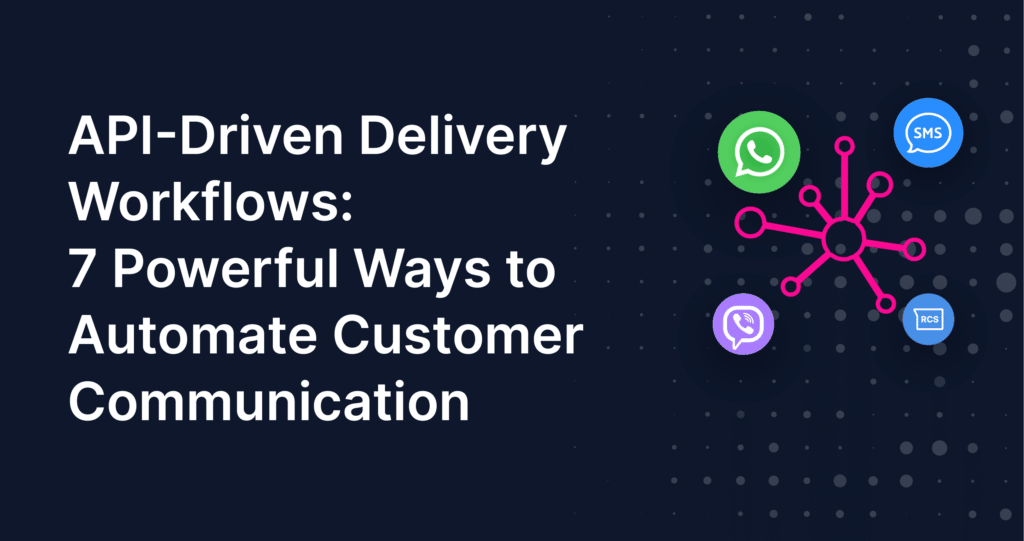
Javna supports this model through APIs, WhatsApp Business messaging, SMS, omnichannel notifications, automation, chatbots, and logistics-focused communication capabilities.
Javna’s logistics offering specifically supports integrating its APIs with logistics software and other business systems to automate notifications and communication flows.
The purpose isn’t to replace the software responsible for planning deliveries. It is to connect what happens during delivery with the people who need to know about it.
API-Driven Delivery Workflows
An API-driven delivery workflow connects operational events with communication actions. Think about a traditional delivery process. A logistics operation may already know that an order has been confirmed, a shipment has left a facility, a delivery schedule has changed, or a package has arrived. But knowing something internally and communicating it to the customer are two different tasks.
Without automation, someone may need to notice the update, choose a communication channel, locate the customer’s details, and send a message.
An API-driven workflow removes much of that manual gap.
The logic can look like this:
Delivery event → API request → Communication platform → Customer notification
For example:
- Shipment dispatched → Send WhatsApp shipping notification
- Delivery schedule changed → Notify the customer or driver
- Package delivered → Send confirmation
Javna’s logistics and delivery solution supports automated shipment alerts, pickup confirmations, delivery notifications, driver coordination, route updates, and customer alerts. Its APIs can be connected with logistics software and business systems to automate notifications and related data flows. The communication therefore becomes connected to an actual operational event rather than depending on someone remembering to send it. That is the foundation of an API-driven delivery workflow.
Why Delivery Communication Needs Automation
Customers usually don’t see what is happening inside a logistics operation. They don’t see the warehouse process. They don’t see dispatch planning. They don’t see how many stops a driver has left. From the customer’s point of view, there can be a long period between placing an order and receiving it. Communication fills that gap.
Without timely updates, customers start asking questions:
- Has my order shipped?
- Where is my package?
- Is it arriving today?
- Why is it late?
- Was the delivery completed?
Those questions are reasonable. But when thousands of customers ask them individually, support teams can become overloaded with conversations that could have been prevented through proactive communication.
Javna’s logistics offering is built around real-time shipment alerts, pickup confirmations, delivery notifications, tracking information, and customer support across WhatsApp, SMS, and chatbot experiences. Automation allows the business to communicate before the customer needs to ask. That changes the customer experience.
Instead of:
Customer becomes uncertain → Customer contacts support → Agent checks status → Agent responds
The experience can become:
Status changes → Customer receives an update
The information is the same. The customer effort is very different. Automation can also help internal operations. Drivers, couriers, partners, and operational teams may need information about pickups, route changes, delivery instructions, or scheduling changes.
Javna supports real-time alerts for drivers and partners through its messaging capabilities, including WhatsApp and SMS communication. The objective is simple: get useful information to the right person when an important delivery event happens.
How API-Driven Delivery Communication Works
An API-driven workflow usually begins with an event in the business’s operational environment.
That event might represent:
- An order confirmation
- A shipment being dispatched
- A pickup
- A delivery-status change
- A schedule update
- A delivery delay
- A failed delivery attempt
- A successful delivery
The business defines which events should create customer or operational communication. When one of those events occurs, its systems can use Javna’s APIs to initiate the appropriate message.
Javna’s API documentation provides programmatic access to channels including WhatsApp and SMS, while its logistics offering is designed to connect customer notifications with delivery operations.
Connect Delivery Events With Customer Messages
The first step is identifying events that customers actually need to know about. Not every internal status deserves a message. A logistics operation may have dozens of internal process states. Sending a notification for every one could overwhelm customers.
Instead, businesses should identify moments that change what the customer needs to know or do.
For example:
- Order confirmed: The customer may need reassurance that the order was received.
- Shipment dispatched: The customer may want tracking information.
- Delivery approaching: The customer may need to prepare to receive the package.
- Delivery schedule changed: The customer may need to adjust their plans.
- Delivery completed: The customer may need confirmation.
Javna supports real-time shipment notifications, tracking links, delivery confirmations, and time-sensitive updates for customers and drivers through WhatsApp. This event-to-message mapping is the core of workflow design.
The question isn’t, “How many notifications can we automate?” It is, “Which notifications make the delivery experience clearer?”
Send Updates Through the Right Channel
Automation is only useful when the message reaches the customer through an appropriate channel. WhatsApp can work particularly well for rich, conversational delivery communication. Businesses can send shipment notifications, tracking information, schedule changes, and delivery confirmations through WhatsApp. SMS provides another valuable option. Because SMS does not depend on the customer actively using a particular messaging application at the time, it can be useful for direct operational notifications.
Javna supports SMS for shipment confirmations, tracking links, driver updates, route changes, delivery instructions, and delivery-status alerts. The right strategy isn’t necessarily to choose one channel forever. Different messages may have different priorities. A business may decide that certain delivery communications belong on WhatsApp while other urgent or operational alerts use SMS.
Javna’s Omnichannel Notify & Alerts capability is designed to send event-triggered updates across channels including WhatsApp and SMS.
Track Messaging Outcomes With Webhooks
Sending the message is one part of automation. Understanding what happened afterward is another. APIs and webhooks can help businesses monitor messaging events. For example, Javna’s SMS API exposes delivery statuses such as pending, sent, failed, delivered, halted, and expired. A successful delivery can also be reported back through a webhook. Webhook subscriptions can notify a business system when message-related events occur, including successful delivery or messaging failure.
Javna’s WhatsApp API also uses webhooks for inbound customer messages and other subscribed events, allowing connected applications to receive customer interactions in real time.
This creates a two-way technical model:
Business system → Customer message
And, where relevant:
Customer or messaging event → Business endpoint
That makes the communication layer easier to integrate into broader operational workflows.
7 Ways to Build Better Delivery Workflows
APIs provide the technical connection. The value comes from choosing the right use cases. Here are seven practical areas where logistics and delivery businesses can use automated communication.
Automate Order and Shipment Confirmations
Uncertainty can begin immediately after a customer places an order. Did the business receive it? Has it entered the delivery process? Has it shipped? Automated confirmations help answer those questions without waiting for the customer to contact support.
Javna enables businesses to send order confirmations and shipment updates through channels including WhatsApp and SMS. A good confirmation should be clear and useful. It can include relevant information such as an order reference or shipment information when that data is available to the workflow.
The customer should understand what happened and what they can expect next. The principle is straightforward: when the delivery journey moves forward, communication should move forward with it.
Share Tracking Information Proactively
One of the most common delivery questions is also one of the easiest to anticipate: Where is my shipment? Customers often ask because they don’t have enough visibility. Proactive tracking communication can reduce that uncertainty.
Javna specifically supports shipment notifications and tracking links through both WhatsApp and SMS for logistics and delivery use cases. nstead of requiring the customer to search for their order confirmation, visit a website, enter a tracking number, or contact customer service, the business can place useful tracking information directly into the communication journey.
That doesn’t mean constantly messaging the customer about every movement. Relevant updates are more valuable than frequent updates. A good tracking strategy focuses on meaningful milestones.
Notify Customers About Delivery Changes
Delivery operations are dynamic. Traffic changes. Routes change. Delivery times change. Unexpected events happen. The problem isn’t that every delivery must follow the original plan perfectly. The bigger problem is leaving customers uninformed when the plan changes.
Javna’s logistics solution supports automated route updates, delay notifications, delivery alerts, and schedule-change communication. Its WhatsApp offering specifically supports notifying drivers or customers about schedule changes.
A useful change notification should answer the customer’s immediate questions:
- What changed?
- Does the customer need to do anything?
- What happens next?
Clear communication can turn an operational disruption into a manageable customer experience. Silence often makes the same disruption feel much worse.
Keep Drivers and Delivery Teams Informed
Delivery communication isn’t only customer-facing. Drivers, couriers, partners, and operational teams may also need time-sensitive updates, including pickup changes, route adjustments, delivery instructions, schedule changes, and operational alerts.
Javna’s SMS offering supports alerts to drivers, couriers, and partners for pickups, route changes, and delivery instructions. Its logistics solution also includes driver coordination and automated route updates. WhatsApp can also be used to communicate schedule changes to drivers or recipients.
This allows communication automation to support both sides of the delivery experience. Customers need visibility. Operations teams need coordination. A connected communication layer can help with both.
Automate Delivery Confirmations
The final delivery event matters. The customer wants to know the shipment arrived. The business wants confirmation that the journey reached its intended endpoint.
Javna supports automated delivery confirmations through WhatsApp as part of its logistics and delivery use cases. Its omnichannel notification offering also supports automatic delivery confirmations and event-triggered order and delivery updates. This is another example of communication following the operational workflow.
Instead of treating the delivery as finished internally while leaving the customer wondering, the final event can create a final notification.
The delivery journey becomes:
Confirmed → Shipped → Tracked → Updated → Delivered
Each message supports the next stage of customer confidence.
Verify Deliveries When Needed
Some delivery journeys require an additional verification step. A business may need to confirm that a shipment is being handed to the intended recipient or verify an action using a one-time code.
Javna’s logistics solution includes omnichannel verification capabilities that can use OTPs across channels such as SMS and WhatsApp for appropriate delivery-verification scenarios.
Verification should be applied where it makes operational and security sense. It isn’t necessary for every delivery. But when confirmation of the recipient matters, adding a verification step can strengthen the workflow. The important point is that verification can become part of the customer communication journey rather than existing as an entirely disconnected process.
Support Customers Throughout Delivery
Automated notifications can prevent many questions. They won’t prevent all of them. A customer may still need help. They may want to ask about a delivery, change information, ask about a failed attempt, or request support after the package arrives.
Javna’s logistics solution includes AI-powered chatbots for interactions such as order tracking, address-change requests, and customer feedback through WhatsApp and web chat.
For issues that need additional attention, Javna’s customer-support capabilities include routing and escalation of conversations.
This gives businesses a useful communication model:
- Proactively notify when possible.
- Automate predictable questions when appropriate.
- Bring people into the conversation when the issue requires human assistance.
Designing an API-Driven Delivery Architecture
A successful workflow shouldn’t begin by connecting every possible API endpoint. It should begin with the delivery journey. Map what happens from order creation to final delivery. Then identify which events matter to customers, drivers, partners, or support teams. Only after that should the communication logic be designed.
Identify the Events That Matter
Begin with operational milestones. For example:
- Order created
- Shipment prepared
- Shipment dispatched
- Delivery scheduled
- Delivery changed
- Driver approaching
- Delivery attempted
- Delivery completed
Not every business will use these exact stages. The goal is to identify the events already generated by the operational environment and decide which ones should trigger communication.
Javna’s logistics capabilities are designed to connect APIs with logistics software and business systems so notifications can respond to delivery activity.
Once events are mapped, define the message associated with each one.
| Delivery event | Communication goal | Possible channel |
| Order confirmed | Reassure the customer | WhatsApp or SMS |
| Shipment dispatched | Confirm shipping and share tracking | WhatsApp or SMS |
| Schedule changed | Inform customer or driver quickly | WhatsApp or SMS |
| Delivery approaching | Prepare recipient | |
| Delivery exception | Explain next step | WhatsApp or SMS |
| Delivery completed | Confirm completion | |
| Post-delivery | Gather feedback or offer support | WhatsApp or chatbot |
This approach keeps technology connected to a clear business purpose. The API call is not the strategy. The customer outcome is.
Plan for Messaging Exceptions
Automation also needs to consider what happens when communication doesn’t proceed normally. Messages can fail. A destination may be unavailable. A message may expire. A channel might not be appropriate for a particular customer.
Javna’s messaging APIs provide status information that allows connected systems to identify outcomes such as delivered or failed messages. Its SMS API, for example, exposes delivery-status notifications through webhooks. Businesses can use this information when designing their own exception logic.
For example, they may determine that certain high-priority notifications should be attempted through another supported channel when their own workflow rules call for it. The key distinction is important: an omnichannel platform provides the channels and communication capabilities. The business should define the operational rules governing when and how those channels are used.
Keep Human Support Available
Some delivery problems cannot be solved by another automated notification. A package may genuinely be missing. A delivery location may be difficult to find. The customer may dispute the delivery status. An unusual operational exception may require investigation. Automation should have boundaries.
Javna’s customer-support tools support escalation and routing of unresolved or high-impact conversations, helping teams manage cases that need human attention. The best workflow isn’t one where people disappear. It is one where people don’t need to spend their time manually performing predictable communication that software can handle reliably.
Measure and Improve Delivery Communication
Once a workflow is running, teams should evaluate it.
- Which notifications are being delivered?
- Where are communication failures happening?
- What questions are customers still asking repeatedly?
- Which delivery events generate the most support contacts?
- Could an earlier notification eliminate some of those contacts?
- Are customers receiving too many messages?
- Are important updates arriving at the right time?
Messaging-status webhooks and customer-support interactions can provide useful signals for this process.
The goal is continuous improvement:
Connect → Notify → Measure → Learn → Improve
Omnichannel Delivery Workflows
WhatsApp is powerful for conversational delivery communication, but logistics businesses shouldn’t necessarily build their entire communication strategy around one channel. SMS remains useful for direct and time-sensitive alerts. WhatsApp allows richer interactions and two-way conversations. Other supported customer-engagement channels may serve additional purposes.
Javna’s Omnichannel Notify & Alerts offering enables event-triggered notifications across WhatsApp, SMS, and additional supported channels for use cases including order updates, shipping alerts, delivery notifications, and tracking information. This allows businesses to design workflows around communication needs rather than channel limitations.
For example:
- A normal shipment update might be delivered through WhatsApp.
- A business may use SMS for another type of urgent operational notification according to its own communication rules.
- A chatbot may help answer a tracking question.
- A support team may take over when an exception becomes complicated.
The experience remains connected even though more than one communication method may be involved.
How Javna Supports API-Driven Delivery Communication
Javna acts as a customer-communication layer for logistics and delivery businesses. Its role isn’t to replace the operational software that manages warehouses, fleets, routes, dispatch, orders, or delivery planning. Instead, Javna allows businesses to connect their systems with communication channels and automate the messages surrounding delivery events.
Javna explicitly supports API integration with logistics software and broader business systems to automate notifications and data flows. Through WhatsApp, logistics businesses can send shipment notifications and tracking links, automate delivery confirmations, and notify customers or drivers about schedule changes. Through SMS, they can send shipment confirmations, tracking links, driver and partner alerts, route changes, delivery instructions, exception updates, and delivery-status notifications.Through Omnichannel Notify & Alerts, delivery events can trigger personalized notifications across supported channels.
Javna’s API environment also supports webhooks, allowing connected applications to receive inbound WhatsApp messages and messaging-event notifications. And when customers need more than an automated update, chatbot and customer-support capabilities can extend the interaction into tracking assistance, address-related requests, feedback, or human support.
The result is a practical communication architecture:
Operational event → API → Javna → Customer or driver
And, where appropriate:
Customer response → Webhook or conversation workflow → Automation or support
That approach lets logistics companies keep their existing operational environment while making communication faster, more proactive, and easier to scale.
Frequently Asked Questions
What are API-driven delivery workflows?
API-driven delivery workflows connect events in a delivery or logistics operation with automated actions in another system. For customer communication, an event such as shipment dispatch, a schedule change, or delivery completion can trigger a relevant notification without requiring someone to send it manually.
Can Javna connect with logistics software?
Yes. Javna’s logistics solution specifically describes API integration with logistics software and other business systems to automate notifications and related data flows.
Can businesses send real-time delivery updates through WhatsApp?
Yes. Javna supports WhatsApp shipment notifications, tracking links, automated delivery confirmations, and alerts about schedule changes for logistics and delivery use cases.
Can Javna send delivery alerts through SMS?
Yes. Javna’s SMS capabilities include shipment confirmations, tracking links, driver or partner notifications, route-change alerts, delivery instructions, and delivery-status communication.
Can APIs help businesses know whether a message was delivered?
Yes. Javna’s messaging APIs expose message-status information. Its SMS API, for example, reports statuses including sent, delivered, failed, halted, and expired and can provide delivery-status events through webhooks.
Can customers reply to automated WhatsApp delivery notifications?
Javna’s WhatsApp API supports both outbound and inbound messaging. Businesses can configure webhook endpoints to receive inbound customer messages in real time and connect them with their own workflows.
Does Javna replace a logistics or delivery management system?
No. Javna should be viewed as the communication and customer-engagement layer in this context. A logistics business can connect its operational systems to Javna’s APIs and use Javna to automate messaging, alerts, verification, and customer conversations.
Can delivery workflows use more than one communication channel?
Yes. Javna supports omnichannel notifications across WhatsApp, SMS, and other supported channels. Businesses can design their own communication rules based on message priority, customer preferences, and operational requirements.
Can Javna automate customer support for delivery questions?
Yes. Javna’s logistics solution includes chatbot support for use cases such as order tracking, address changes, and feedback. More complex customer-support situations can be routed or escalated according to the organization’s support workflow.
Conclusion
Modern delivery operations generate information continuously.Orders are confirmed. Packages move. Schedules change. Drivers receive instructions. Customers wait. Deliveries succeed—or occasionally encounter problems. The challenge is making sure the right people know what is happening without turning communication into a manual operational burden. That’s where API-driven delivery workflows become valuable.
APIs connect delivery events with communication. WhatsApp can provide rich, conversational updates. SMS can provide direct alerts. Webhooks can return messaging events and customer responses to connected systems. Automation can handle predictable communication. Chatbots can answer routine delivery questions. And people can step in when an exception requires human judgment.
Javna provides the communication capabilities that allow logistics and delivery organizations to build these connected workflows without presenting Javna as the system responsible for managing the logistics operation itself. The distinction is important. The logistics environment determines what happened. Javna helps communicate what the customer, driver, or partner needs to know about it. When those two layers work together, delivery communication can become faster, more proactive, and easier to scale.
Key Takeaways About API-Driven Delivery Workflows
- Connect operational events to communication: APIs can turn shipment, scheduling, and delivery events into timely customer or driver notifications.
- Communicate proactively: Tracking links, shipment alerts, and schedule updates can reduce uncertainty before customers need to contact support.
- Use the appropriate channel: Javna supports delivery communication across WhatsApp and SMS, alongside broader omnichannel notification capabilities.
- Monitor messaging outcomes: API status information and webhooks can help connected systems understand whether communications were delivered or encountered problems.
- Keep automation connected to human support: Routine updates can be automated while delivery exceptions can move toward appropriate support processes.
- Use Javna as the communication layer: Javna connects logistics systems with messaging, notifications, verification, chatbots, and customer engagement without needing to replace the business’s underlying delivery-management environment.