
A patient wants to book an appointment. Another needs to confirm tomorrow’s visit. Someone else wants to know the clinic’s location or opening hours. The questions may be simple. The language may not be.
Across the Middle East, healthcare providers often communicate with patients from different linguistic backgrounds. Arabic and English are widely used across the region, while many communities also communicate in additional languages.
For clinics, doctors, laboratories, and medical centers, this can create a practical communication challenge. A message that is perfectly clear to one patient may be difficult for another to understand. That is where multilingual patient communication becomes important.
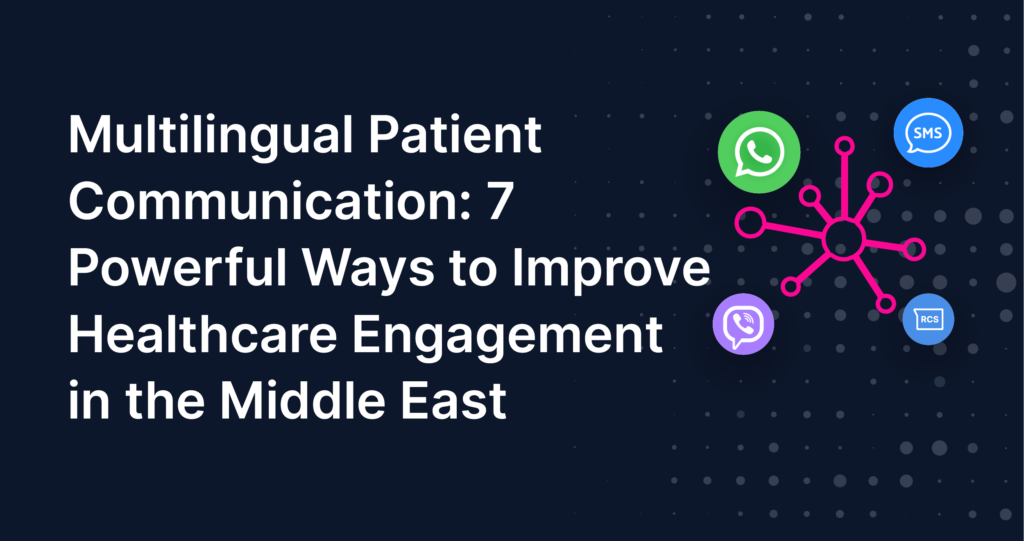
The goal is not to turn customer-engagement technology into a medical translator. It is to help healthcare organizations make everyday communication more accessible, consistent, and easier to understand across digital channels. WhatsApp, SMS, web chat, and chatbots can all play a role.
Javna provides healthcare organizations with customer-engagement tools for appointment reminders, patient FAQs, notifications, follow-ups, and centralized communication across WhatsApp, SMS, and web chat. Its no-code chatbot platform also supports multiple languages, with native Arabic and English support and right-to-left experiences.
That creates an opportunity for healthcare providers in the Middle East to communicate with more patients in the language and channel that feels familiar to them.
Multilingual Patient Communication
Multilingual patient communication means giving people access to appropriate administrative and service-related information in more than one language.
In healthcare, this can include everyday interactions such as:
- Appointment confirmations
- Appointment reminders
- Clinic opening hours
- Location information
- Booking instructions
- General FAQs
- Preparation information
- Service notifications
- Follow-up messages
- Feedback requests
These interactions are not the same as clinical interpretation. That distinction is important.
A multilingual chatbot can help answer a question about clinic hours. It should not automatically be treated as a substitute for a qualified professional interpreting a diagnosis, treatment decision, or other sensitive medical information.
For Javna, the strongest role is therefore multilingual patient engagement, not medical translation.
Javna’s healthcare offering supports automated patient communication from booking through follow-up across WhatsApp, SMS, and chatbots. Its healthcare use cases include appointment scheduling, reminders, onboarding, education, follow-ups, feedback, and billing-related notifications.
Its multilingual chatbot platform adds another layer by allowing organizations to build automated experiences across WhatsApp, Instagram, Messenger, and web chat, with native support for Arabic and English.
Together, these capabilities can help healthcare organizations make routine communication easier for patients who prefer different languages.
Why Multilingual Communication Matters in Middle Eastern Healthcare
The Middle East is linguistically diverse. Patients and healthcare staff may not always share the same first language. That can make even simple administrative interactions harder than necessary.
A patient may understand conversational English but prefer appointment details in Arabic. Another may be comfortable speaking Arabic but prefer written English. Others may need help understanding routine instructions before arriving at a clinic.
Language barriers can create misunderstanding in healthcare environments. For Javna, the practical opportunity is to focus on the parts of communication that can be made clearer through customer-engagement technology. Consider an appointment reminder. A reminder is only useful if the patient understands it.
The same applies to:
- Check-in instructions
- Booking information
- Working hours
- Location details
- Payment notifications
- Follow-up messages
If these messages are available in the patient’s preferred language, communication can become easier to follow. This can also reduce unnecessary back-and-forth.
Instead of a patient receiving a message they do not understand and then calling the clinic for clarification, the communication journey can be designed more thoughtfully from the beginning.
Javna supports automated appointment confirmations and reminders through WhatsApp and SMS, while its chatbot platform provides multilingual automated interactions. The benefit is not simply translation. It is clarity at the right moment.
Where Multilingual Communication Fits in the Patient Journey
Patient communication happens at many stages. It begins before the appointment, continues during preparation, and may continue after the visit.
A multilingual communication strategy can support several parts of that journey without crossing into medical decision-making.
A simple journey may look like this:
Inquiry → Booking → Reminder → Visit → Follow-Up → Feedback
Each stage creates a different communication need.
Appointment Booking
Booking is often the first direct interaction a patient has with a healthcare provider. If that interaction is difficult to understand, the journey starts with friction. A multilingual chatbot can help answer routine booking questions or guide the patient through a predefined appointment process.
Javna’s healthcare offering includes appointment scheduling among its supported communication use cases, while its multilingual chatbot builder supports automated conversations across major digital channels.
This can be particularly useful for common questions such as:
- What times are available?
- Where is the clinic?
- What are your opening hours?
- How can I confirm my appointment?
These are administrative questions and are well suited to automation.
Appointment Confirmations and Reminders
Appointment communication should be simple.
The patient needs to know:
- When is the appointment?
- Where is it?
- Does the patient need to take any action?
Javna supports automated appointment confirmations and reminders through WhatsApp and SMS.
If a healthcare provider serves multilingual audiences, those reminders can be designed in the appropriate supported language for the patient communication workflow.
The purpose is not to add more text. It is to make the essential information easier to understand.
General Patient FAQs
Healthcare teams answer many routine questions repeatedly:
- What are your opening hours?
- Where are you located?
- How can I reschedule?
- Which department should I contact?
- What should I bring to my appointment?
These questions can often be automated.
Javna’s healthcare offering includes AI chatbots for patient FAQs, while its multilingual chatbot platform supports Arabic and English experiences.
That can help healthcare organizations make basic support available beyond normal office hours. The patient gets an immediate answer, and staff avoid repeating the same information manually.
Pre-Visit Information
Patients may need general information before arriving. This might include:
- Location
- Opening hours
- Check-in steps
- What documents to bring
- General preparation information provided by the clinic
Javna supports patient onboarding and educational communication as part of its healthcare engagement offering.
When this information is provided in the patient’s preferred language, it can be easier to follow. However, healthcare organizations should distinguish routine administrative information from medical instructions that may require professional interpretation or review. That distinction should remain clear.
Follow-Up Communication
Healthcare communication often continues after an appointment. A provider may send a general follow-up, request feedback, or share a reminder related to a future appointment.
Javna supports automated follow-ups and feedback workflows in its healthcare use cases. Multilingual follow-up communication can make these interactions easier for patients who prefer another supported language.
Again, the strongest use case is administrative communication. Clinical advice should remain within the healthcare provider’s professional processes.
Billing and Payment Notifications
Billing communication can also be confusing when language gets in the way.
A patient may need to know:
- A payment is due
- A payment was received
- A billing update occurred
Javna’s healthcare solution includes billing and payment notifications, while its omnichannel notification platform supports real-time payment and transaction alerts.
Clear multilingual wording can help patients understand what happened and what they need to do next.
Patient Feedback
Feedback is often easier to collect when the patient can understand the question clearly.
Javna supports follow-up and feedback interactions as part of its healthcare engagement capabilities.
A multilingual feedback journey can help healthcare organizations gather input from a wider range of patients. That information can then be used to improve service communication.
7 Powerful Ways to Improve Multilingual Patient Communication
Healthcare organizations do not need to redesign every communication process at once. The strongest strategy usually begins with the interactions that happen most often.
Offer Arabic and English Digital Experiences
Arabic and English are central languages for many organizations operating across the Middle East.
Javna’s multilingual chatbot builder provides native support for Arabic and English, including full right-to-left experiences for Arabic.
This is important because multilingual communication is not only about translating words. The interface itself should also feel natural.
Arabic content needs to display correctly. Navigation should make sense. Text direction should not become another source of friction.
A properly designed right-to-left experience can therefore improve the usability of Arabic patient journeys.
Automate Routine Questions in Multiple Languages
Repeated administrative questions are one of the easiest areas to automate. Healthcare providers can identify the questions they answer most often and create multilingual responses.
For example:
- Opening hours
- Clinic location
- Appointment procedures
- General department information
- How to request assistance
Javna’s no-code chatbot platform enables organizations to create automated flows without development resources, while supporting Arabic and English.
This can reduce pressure on reception and support teams. It also gives patients faster access to basic information.
Send Appointment Reminders in Clear Language
A reminder should be easy to understand immediately. Healthcare providers can keep messages concise and structured. For example, an appointment reminder should prioritize:
- Date
- Time
- Location
- Next action
Javna supports appointment reminders through both WhatsApp and SMS.
The communication should be written for clarity rather than formality. Simple language often works better.
Let Patients Use Familiar Channels
Language is one part of accessibility. Channel familiarity is another. Some patients may prefer WhatsApp. Others may respond better to SMS. Some may begin their interaction through web chat.
Javna’s healthcare communication offering spans WhatsApp, SMS, and web chat, while patient messages can be managed within a unified environment.
That allows healthcare providers to build communication around the channels patients already use. The goal should not be to force every patient into one communication method.
Keep Human Support Available
Multilingual automation can help with routine interactions. It should not become a barrier when the patient needs a person. A chatbot may successfully answer, “What time does the clinic open?” But it may not be appropriate to handle every situation.
When the patient has an unusual request, cannot understand the automated flow, or needs assistance beyond the chatbot’s defined scope, human support should remain available.
Javna’s broader platform supports handover between AI-driven automation and human agents.
That creates a better balance:
- Automation for repetitive communication.
- People for conversations that require judgment or additional care.
Separate Administrative Communication From Clinical Interpretation
This is one of the most important rules. A multilingual customer-engagement platform can help communicate administrative information. That does not mean it should automatically translate or interpret sensitive medical conversations.
Clinical information may require qualified professionals, approved processes, and appropriate safeguards. Healthcare providers should decide which messages can safely be automated and translated within their communication environment.
A useful distinction is:
| Administrative communication | Clinical communication |
| Appointments | Diagnosis |
| Opening hours | Treatment decisions |
| Locations | Medical interpretation |
| Confirmations and reminders | Detailed medical advice |
| General service information | Sensitive clinical information |
Javna should be positioned around the first category. It is a communication and customer-engagement platform, not a licensed medical translation service.
Review Language Journeys Regularly
Languages change in practice. Patients use different words, questions appear repeatedly, and some automated answers may be technically correct but still difficult to understand.
Healthcare providers should therefore review multilingual workflows regularly.
Ask:
- Which questions are patients repeating?
- Where do they abandon chatbot journeys?
- Which messages lead to clarification calls?
- Do Arabic and English journeys provide the same useful information?
- Does the Arabic interface display correctly?
- Are patients being routed to people when necessary?
This creates an improvement cycle:
Communicate → Observe → Learn → Improve
Multilingual Chatbots in Healthcare Communication
Chatbots can be particularly useful in multilingual healthcare environments because many patient questions are repetitive. A clinic does not need someone manually typing its address fifty times per day. It does not need a receptionist to repeatedly explain opening hours. These are predictable interactions.
Javna’s multilingual AI chatbot builder lets organizations create no-code automated experiences across WhatsApp, Instagram, Messenger, and web chat, with native Arabic and English support.
For healthcare providers, this can support workflows such as:
Patient asks a question → Chatbot follows the designed conversation path → Patient receives an appropriate response → Patient continues through the workflow → Human support takes over when needed
The important word is designed. Healthcare organizations should define what the chatbot is allowed to do.
The chatbot should not be presented as a doctor. It should not be treated as a substitute for clinical judgment. The safest and most useful role is often helping with routine patient communication.
WhatsApp and SMS for Multilingual Healthcare Communication
WhatsApp and SMS can support different parts of the communication journey.
WhatsApp is useful when the interaction may become conversational.
Javna supports healthcare use cases such as appointment reminders and 24/7 patient support through WhatsApp. The patient can also continue the conversation when appropriate.
This makes WhatsApp useful for:
- FAQs
- Appointment communication
- General support
- Follow-ups
- Two-way administrative conversations
SMS
SMS works well for concise, direct updates.
Javna supports healthcare SMS use cases including appointment confirmations and reminders, lab-related notifications, and general health communication.
For the purpose of this article, the strongest Javna positioning is around:
- Appointment reminders
- Notifications
- Administrative updates
Healthcare organizations should still determine which information is appropriate to send through each channel.
Using Both Channels
A multilingual strategy should not automatically send every message through both WhatsApp and SMS. That can create duplication.
Instead, organizations can define channel rules.
| Patient interaction | Possible channel | Multilingual consideration |
| Appointment reminder | WhatsApp or SMS | Keep wording short and clear |
| FAQ | WhatsApp chatbot or web chat | Offer supported language options |
| Clinic location | WhatsApp or web chat | Use simple language and directions |
| Booking confirmation | WhatsApp or SMS | Clearly show date and time |
| General follow-up | Allow replies when appropriate | |
| Service notification | WhatsApp or SMS | Prioritize essential information |
| Feedback | WhatsApp or web chat | Make questions easy to understand |
The point is coordination. Different channels can support different communication needs while keeping the patient experience consistent.
Designing a Multilingual Patient Communication Strategy
Technology should come after the communication plan. Healthcare providers should first decide who they need to communicate with and what information those patients need.
Identify the Most Common Languages
Begin with actual patient data and service experience. Which languages do patients use? Which languages generate the most support requests? Where do communication gaps appear?
For many organizations in the region, Arabic and English may be the first priority. Javna’s chatbot platform directly supports both.
If an organization needs additional languages, it should confirm the specific implementation and supported workflow before promising them to patients.
Prioritize High-Volume Interactions
Not every message needs to be multilingual on day one. Start with the most common interactions:
- Appointment confirmations
- Reminders
- Opening hours
- Directions
- FAQs
- Booking assistance
These interactions happen frequently and can create a noticeable reduction in communication friction.
Keep Language Simple
Healthcare communication often becomes more complicated than necessary. Long sentences, technical words, and administrative jargon make multilingual communication harder.
Simple language is easier to understand and easier to maintain across languages.
For example:
Instead of: “Your scheduled medical consultation has been confirmed for the aforementioned date.”
Use: “Your appointment is confirmed for Tuesday at 10:00 AM.”
Simple messages reduce ambiguity.
Maintain Consistency Across Channels
A patient should not receive one answer on WhatsApp and a different answer through web chat. Multilingual communication needs content consistency. Opening hours, appointment instructions, and location details should match across channels.
Javna’s unified inbox helps organizations centralize patient conversations across channels including WhatsApp, SMS, Instagram, and web chat.
A unified communication environment can make it easier for teams to manage conversations consistently.
Review Sensitive Communication Carefully
Healthcare organizations should apply additional care to any message involving sensitive or clinical information.
Javna’s public healthcare materials include broader health-related communication use cases. However, for the positioning used here, Javna should remain framed as a communication platform for healthcare providers, not a medical platform, diagnostic system, or clinical translation service.
Each healthcare organization remains responsible for deciding what information should be communicated digitally and how.
How Javna Supports Multilingual Patient Communication
Javna can support multilingual healthcare communication in several practical ways. Its no-code AI chatbot builder is designed for multilingual customer interactions and includes native Arabic and English support with right-to-left experiences.
Its healthcare offering supports appointment confirmations and reminders, FAQs, patient onboarding, follow-ups, feedback, and other customer-engagement workflows across WhatsApp, SMS, and chatbots.
Its WhatsApp Business Platform supports healthcare communication and 24/7 virtual assistance for patient questions and general inquiries.
Its SMS API supports appointment confirmations and reminders for clinics and healthcare providers.
Its unified customer-engagement platform allows patient conversations from multiple digital channels to be managed through one inbox.
This creates a practical model:
Patient chooses a digital channel → Communication appears in an appropriate supported language → Automation handles predictable questions → The patient receives reminders or updates → Human staff take over when necessary
Javna’s role remains the communication layer.
- It does not become the doctor.
- It does not replace medical professionals.
- It does not replace a certified medical interpreter.
- It does not require claims of healthcare licensing or official medical-system integration.
That positioning is both accurate and useful.
Frequently Asked Questions
What is multilingual patient communication?
Multilingual patient communication means providing appropriate patient-facing information in more than one language. In digital healthcare engagement, this can include appointment reminders, booking information, FAQs, clinic details, service notifications, and follow-ups.
Does Javna support multilingual chatbots?
Yes. Javna’s no-code chatbot builder supports multilingual experiences, with native Arabic and English support and full right-to-left functionality for Arabic.
Can Javna send appointment reminders in healthcare?
Yes. Javna supports automated appointment confirmations and reminders through WhatsApp and SMS for healthcare communication.
Can healthcare providers use WhatsApp for multilingual patient FAQs?
Yes. Javna supports WhatsApp-based patient support and chatbot experiences. Its multilingual chatbot builder supports Arabic and English, making it suitable for routine administrative FAQs in those supported languages.
Is Javna a medical translation platform?
No. Javna should be positioned as a customer-engagement and communication platform. It can support multilingual patient communication, but it should not be presented as a medical interpretation service or a replacement for qualified clinical translators.
Can Javna translate medical diagnoses or treatment instructions automatically?
That should not be assumed or positioned as a Javna capability. Sensitive clinical interpretation should remain within the healthcare provider’s professional processes. Javna is best used for appropriate communication and customer-engagement workflows.
Does Javna need a healthcare-system integration to support multilingual patient communication?
No such integration is required for the general communication use cases discussed here. Clinics, doctors, and medical centers can use Javna for messaging, reminders, FAQs, chatbots, and conversation management without positioning Javna as an integrated medical system.
Which channels can healthcare providers use with Javna?
Javna supports healthcare communication across channels including WhatsApp, SMS, and web chat, with conversations and automated engagement managed through its broader platform.
Does multilingual communication replace human support?
No. Automation can handle routine questions and repetitive administrative tasks, while human teams should remain available for complex, sensitive, or unusual conversations.
Why are Arabic and English important for Javna’s MENA healthcare strategy?
Javna’s multilingual chatbot builder provides native support for Arabic and English and includes full right-to-left functionality, making these languages a strong foundation for organizations serving diverse audiences in the Middle East.
Conclusion
Healthcare communication does not become multilingual simply by translating a few words. The experience needs to make sense to the patient. The language should be clear. The interface should work correctly. The channel should be familiar. The information should arrive at the right moment. And when automation is not enough, a person should be available. For healthcare providers in the Middle East, multilingual patient communication can improve the everyday parts of the patient journey.
Appointments can be easier to confirm. Reminders can be easier to understand. Routine questions can be answered faster. Patients can receive information through WhatsApp, SMS, or web chat. Arabic and English chatbot experiences can help healthcare providers serve more patients consistently. Support teams can also manage conversations without having to manually repeat the same information all day.
Javna provides the communication technology behind these interactions through multilingual chatbots, WhatsApp, SMS, web chat, automation, and unified conversation management. But its role should remain clearly defined.
Javna is not a medical provider. It is not a medical translation service. It is not a hospital information system. And it does not need to be presented as having healthcare licenses or official medical integrations.
Javna helps healthcare providers communicate. That is where the value of multilingual engagement becomes strongest: give patients clearer information, in a language they can understand, through a channel they already use.
Key Takeaways About Multilingual Patient Communication
- Focus on everyday communication: Multilingual patient communication works especially well for appointments, reminders, FAQs, directions, notifications, and follow-ups.
- Support Arabic and English properly: Javna’s multilingual chatbot builder provides native Arabic and English support with full right-to-left experiences.
- Use WhatsApp, SMS, and web chat strategically: Different channels can support different parts of the patient journey.
- Keep automation within clear boundaries: Routine administrative questions can be automated, while sensitive or clinical conversations should remain with appropriate professionals.
- Maintain access to human staff: Multilingual chatbots should make communication easier, not prevent patients from reaching people when needed.
- Position Javna accurately: Javna provides multilingual customer-engagement and communication capabilities for healthcare providers; it should not be presented as a licensed medical system, clinical translation service, or replacement for healthcare professionals.