
A promotion goes live. Thousands of customers need to know about it. Some prefer Arabic. Others communicate comfortably in English. Some customers may be interested in the offer. Others may have already purchased the product. And not every customer should receive the same message at the same time.
This is where SMS marketing in Saudi Arabia becomes more than simply sending a large number of text messages. Successful SMS marketing requires relevance.
It needs clear language, sensible timing, appropriate audience selection, recognizable sender information, useful calls to action, and respect for the rules governing promotional communication in the Kingdom.
For businesses operating in Saudi Arabia, regulatory considerations are especially important. The Communications, Space & Technology Commission, or CST, currently regulates telecommunications services in the Kingdom and maintains regulations covering SMS services as well as spam messages and calls. Technology can make the operational side easier.
Javna provides an SMS API that allows businesses to send individual or bulk SMS messages, schedule messages, use approved sender names, connect SMS with applications, and monitor message status. Its CPaaS environment also provides campaign management, contact organization, reporting, and performance tracking capabilities. But technology alone does not make a campaign effective.
A better question is:
How can businesses use SMS to send the right message to the right audience at the right moment?
That is the foundation of a stronger SMS marketing strategy in Saudi Arabia.
SMS Marketing in Saudi Arabia
SMS marketing is the use of text messaging to communicate promotional or engagement messages to customers who are appropriate recipients of those communications.
A business might use SMS to announce:
- A seasonal offer
- A limited-time promotion
- A new product
- A store event
- A discount
- A loyalty benefit
- A special customer campaign
SMS can also be used for non-promotional communication such as OTPs, order confirmations, payment notifications, reminders, and service alerts.
Those transactional messages and marketing messages should not automatically be treated as the same thing. The purpose of the message matters.
Javna’s SMS API supports both individual messaging and bulk SMS. Its documentation describes bulk messaging as suitable for marketing campaigns, event announcements, and other situations where a message needs to reach a larger audience.
Javna’s campaign environment also allows a business to create a campaign and select SMS as the communication channel using an available SMS Sender ID. That makes the technical process straightforward.
However, the marketing strategy still needs to answer several questions:
- Who should receive this campaign?
- Why is the message relevant to them?
- Which language should be used?
- When should the campaign arrive?
- What action should the customer take?
- How will success be measured?
- And does the campaign meet the applicable requirements for promotional messaging in Saudi Arabia?
When those questions are answered first, SMS becomes much more useful than a simple broadcasting tool.
Why SMS Still Matters for Customer Communication
Business messaging has expanded dramatically. Customers now communicate through WhatsApp, social media, mobile applications, email, web chat, and many other channels.
SMS still has an important place within that wider communication mix. Its main strength is simplicity. A business can send a short message directly to a mobile number without asking the customer to open a particular social application or enter a chatbot journey. For a marketing campaign, this makes SMS useful when the message itself can be expressed clearly and briefly.
For example:
Weekend offer now available. Shop before Saturday.
The message has one purpose.
The customer understands it quickly.
The next action is clear.
SMS can also be integrated directly with business applications.
Javna’s SMS API follows a RESTful structure and supports outbound messaging from connected applications. Messages can be sent individually or to multiple recipients, and POST-based SMS messages can be scheduled for future delivery.
This means SMS marketing does not need to be a manual activity. A business can build SMS into campaign workflows, customer journeys, CRM-related processes, or other appropriate systems. That becomes especially useful as the customer base grows.
7 Powerful Ways to Improve SMS Marketing in Saudi Arabia
The strongest SMS campaigns are rarely the longest. They are usually the most relevant. Businesses can improve SMS marketing by focusing on seven practical areas.
Communicate in the Customer’s Preferred Language
Language is one of the first considerations for any marketing campaign in Saudi Arabia. Arabic is central to communication in the Kingdom.
English is also widely used in business and among many residents and expatriate communities. The mistake is assuming one language automatically fits every customer.
A better approach is to use customer information and segmentation to determine which language is appropriate for each audience.
For example, if a business already knows that one customer prefers Arabic and another prefers English, campaign groups can be organized accordingly.
Javna’s CPaaS Address Book allows organizations to manage contacts, organize them into groups, and assign custom attributes.
Those types of attributes can help businesses structure their audiences according to their own customer data.
The important distinction is that the communication platform does not magically know a person’s preferred language unless that information is available to the business or captured through the customer journey.
Businesses should manage preference data carefully rather than guessing. Good multilingual SMS communication should also avoid unnecessary complexity. Arabic messages should sound natural in Arabic.
English messages should not simply be literal copies if a different phrase communicates the idea more clearly. The goal is comprehension, not word-for-word duplication.
Keep Every SMS Clear and Concise
SMS rewards clarity. Customers often read messages quickly. They may be walking, working, shopping, or checking their phone between other tasks.
A complicated message creates unnecessary friction.
Compare:
Our organization is pleased to announce the commencement of our promotional seasonal campaign involving a selected assortment of products.
with:
Weekend offer: Save 20% on selected items until Saturday.
The second message reaches the point much faster.
Strong SMS marketing usually answers three questions:
- What is happening?
- Why should I care?
- What should I do next?
Anything that does not support one of those questions may be unnecessary.
This is especially important when communicating in Arabic and English, because message length and encoding can also affect the technical composition of SMS segments.
Businesses should test messages before launching high-volume campaigns and understand how their chosen text is handled within their messaging setup.
Clear language also helps customers distinguish useful brand communication from confusing or suspicious messaging.
Segment Audiences Before Sending Campaigns
Sending every campaign to every contact is rarely the strongest marketing strategy. Different customers have different interests. One customer may have recently purchased. Another may not have engaged for months. Another may be interested in a specific product category. Another may belong to a loyalty group.
If everyone receives exactly the same message, relevance falls quickly. Segmentation helps businesses organize audiences around useful customer information.
Javna’s CPaaS platform includes an Address Book where contacts can be grouped and assigned custom attributes. It also provides campaign functionality for managing marketing communications.
The business decides how those groups should be created.
Possible segments could include:
| Audience segment | Possible campaign approach |
| Existing customers | Loyalty or repeat-purchase communication |
| Recently active customers | Relevant current offers |
| Inactive customers | Carefully designed re-engagement |
| Arabic-preference audience | Arabic campaign copy |
| English-preference audience | English campaign copy |
| Specific product interest | Category-related promotion |
| Location-based customer group | Relevant branch or local campaign |
The more specific the audience, the easier it becomes to write a meaningful message. Segmentation also helps reduce unnecessary messaging. A customer who has already acted on an offer does not necessarily need to keep receiving reminders about it.
Choose Timing and Frequency Carefully
A good message can become a bad customer experience when it arrives at the wrong time. Timing affects attention. Frequency affects trust. Businesses should think about both before launching a campaign.
An SMS sent in the middle of the night may be technically successful but commercially unhelpful. A customer who receives repeated promotional messages every day may begin ignoring the brand.
And sending messages simply because the technology allows high volume is not a strategy.
Campaign timing should reflect:
- The purpose of the campaign
- The customer journey
- The relevance of the offer
- Applicable communication rules
- The expected customer action
Javna’s SMS API supports scheduled message delivery, allowing businesses to choose a future sending time rather than sending every campaign immediately.
Javna’s broader campaign functionality also supports scheduling campaign delivery. That gives marketers control over execution. But the marketing team still needs to choose the timing responsibly. There is no universal frequency that is correct for every Saudi business.
A supermarket, bank, travel business, online retailer, and educational organization may all have very different communication needs. The best rule is relevance. If the message provides little value, increasing frequency will not improve it.
Use a Recognizable and Approved Sender Name
Trust begins before the customer reads the message. They need to understand who is contacting them.
Javna’s SMS API uses predefined and verified sender names, which may be a business or brand name. Before sending outbound SMS messages, Javna’s onboarding documentation instructs users to register the sender names they plan to use and ensure those sender names are approved.
This is particularly relevant in Saudi Arabia, where promotional SMS is part of a regulated telecommunications environment. CST also provides mechanisms for users to report unwanted messaging and explains that advertising SMS messages use a sender tag marked to indicate advertising content.
Businesses should therefore treat sender identity as more than a branding decision. They should ensure their messaging setup and campaign practices follow the applicable requirements of telecommunications operators and CST.
Javna can provide the SMS technology and sender-management capability. It should not be presented as replacing the organization’s responsibility to meet Saudi regulatory requirements.
Give Every Campaign a Clear Call to Action
A promotional SMS should have a purpose.
Do you want the customer to visit a store?
Open a product page?
Use a discount?
Register for an event?
Complete a purchase?
The message should make that next action obvious.
A weak SMS might say:
Great offers are available now.
A stronger version might say:
Weekend offer: Save 20% on selected items until Saturday. Shop now: [link]
The second message provides:
- Offer
- Value
- Deadline
- Next action
Not every campaign needs all four elements.
But every campaign should give customers enough context to understand what they can do next.
Calls to action should also match the audience. For example, a loyalty customer might receive a different offer from a new customer. A location-specific campaign might direct people to a nearby store. A re-engagement campaign might encourage customers to return to a website. This is where segmentation and copywriting work together.
Measure Results and Improve Future Campaigns
A campaign is not finished when the messages are sent. That is when learning begins.
Javna assigns individual SMS messages unique IDs and provides message-status information that businesses can monitor. Its SMS API reports statuses including Pending, Sent, Failed, Halted, Delivered, and Expired. Delivery results can also be returned through configured webhooks.
The Javna CPaaS platform also provides message logs and campaign performance management.
This allows teams to answer operational questions such as:
- Did the messages enter the sending process?
- Were they delivered?
- Did some messages fail?
- Are there problems with a sender name?
- Did messages expire?
Marketing teams can then combine messaging data with their own website, CRM, campaign, or conversion data to understand broader business outcomes.
It is important to distinguish these metrics. Delivered does not automatically mean read. And read does not automatically mean converted. Businesses should avoid presenting SMS delivery reports as proof that customers opened a message or purchased something. Instead, connect different sources of measurement.
For example:
SMS delivery information + tracked campaign link + website conversion data
That creates a more realistic view of campaign performance.
Building an SMS Marketing Campaign Step by Step
An effective Saudi SMS campaign should start before the first message is written.
Define the Campaign Goal
Begin with one clear objective.
For example:
- Increase weekend store visits
- Promote a seasonal product range
- Re-engage inactive customers
- Announce a new service
- Promote an event
The more specific the objective, the easier it becomes to decide who should receive the message and what the call to action should be.
A campaign with five different objectives often produces a confusing SMS.
Select the Appropriate Audience
Next, determine who should receive the campaign.
Avoid starting with:
Send to everyone.
Instead, ask:
- Who is likely to find this useful?
- Do we have permission and the appropriate basis to contact this audience?
- What information do we have about their language or interests?
- Are there customers who should be excluded?
Javna’s contact management capabilities can help businesses organize customer groups and custom attributes within their CPaaS environment.
The business remains responsible for deciding which contacts should receive promotional communication.
Write for the Mobile Screen
An SMS should be understandable within seconds.
A practical structure is:
Brand/context + offer + important condition + action
For example:
Weekend Deal: 20% off selected products until Saturday. Shop: [link]
Arabic messaging should receive the same attention.
Do not write English first and assume an automatic literal translation will create the best Arabic marketing message. Review the Arabic copy as marketing content in its own right.
Check Sender Setup Before Launch
Javna requires outbound SMS sender names to be registered and approved before use.
Teams should confirm that:
- The intended sender name is configured
- The sender is appropriate for the destination
- The campaign is using the correct contact list
- The message is final
- Links work
- Timing is correct
- Applicable regulatory requirements have been reviewed
A small pre-launch checklist can prevent a large campaign mistake.
Schedule the Campaign
Once the message is ready, schedule it for the selected time. Javna supports SMS scheduling through its API and campaign environment.
Scheduling is useful for planned promotions because the marketing team can prepare the campaign in advance while controlling when customers actually receive it.
Monitor Message Delivery
After sending, review status information. Javna’s SMS message statuses provide visibility into whether messages are pending, sent, delivered, failed, halted, or expired. A high failure rate should not simply be ignored.
Teams can investigate whether the issue involves:
- Contact data
- Sender configuration
- Destination numbers
- Network conditions
- Other technical issues
The objective is to understand the campaign’s delivery quality.
Use Results to Improve the Next Campaign
Finally, connect the campaign results to the next decision. If one audience segment performs better, study why.
If an Arabic campaign generates more engagement among an Arabic-preference segment, use that learning.
If a campaign produces delivery problems, resolve those before repeating the same approach.
If customers opt out or complain, review relevance and frequency.
The process becomes:
Plan → Segment → Send → Measure → Learn → Improve
That is how SMS marketing becomes a repeatable discipline rather than a series of isolated broadcasts.
Arabic and English SMS Marketing in Saudi Arabia
Multilingual marketing deserves additional attention in Saudi Arabia. The original reference article correctly identified language as a major part of the Saudi SMS environment, although some of its demographic statistics are now dated because the article was published in May 2023.
A stronger modern strategy is not to rely on one national demographic assumption. Use your own customer data.
If customers have explicitly expressed language preferences, use them.
If your business serves distinct Arabic and English customer groups, design communication for each group intentionally.
Consider this simple comparison:
| Poor approach | Better approach |
| Send English to every customer | Use known customer language preferences |
| Translate word-for-word | Adapt copy naturally |
| Use long formal sentences | Keep language clear and direct |
| Mix languages unnecessarily | Keep each journey consistent |
| Guess the customer’s language | Use reliable preference data where available |
Arabic SMS copy should also consider readability.
Use familiar terminology.
Avoid unnecessary technical language.
Keep the call to action clear.
And if a campaign uses a link, make sure the destination experience matches the language of the SMS when practical.
A polished Arabic SMS that sends the customer to an English-only landing page can still create friction.
The campaign journey should be considered end to end.
Compliance and Responsible SMS Marketing in Saudi Arabia
This section is particularly important because the regulatory environment has changed in naming since the competitor article was originally published.
The 2023 article refers to the Communications and Information Technology Commission (CITC). Today, the Saudi regulator is the Communications, Space & Technology Commission (CST). CST publishes regulations for SMS services as well as regulations intended to curb spam messages and calls.
CST also provides consumers with a spam-reporting service and information for identifying advertising SMS messages.
Businesses running SMS marketing in Saudi Arabia should therefore treat regulatory compliance as part of campaign planning.
They should understand the requirements applicable to their business, messaging provider, sender identity, recipients, consent or permission practices, content, timing, opt-out handling, and other relevant obligations.
This article should not be treated as legal advice.
Requirements can change, and different organizations may face different obligations depending on their activities and communications.
For current official requirements, businesses should consult CST guidance directly:
CST Regulations for Curbing SPAM Messages and Calls
Javna’s role in this process is the communication technology.
Its SMS platform requires sender-name registration and provides tools for sending, scheduling, tracking, and managing SMS communication.
Javna should not be presented as removing the sender’s responsibility to comply with applicable Saudi regulations.
SMS Marketing vs Transactional SMS
Marketing teams should also distinguish promotional communication from transactional communication.
Consider the difference:
| Marketing SMS | Transactional SMS |
| Seasonal discount | Order confirmation |
| New product promotion | Payment update |
| Flash sale | Delivery notification |
| Re-engagement offer | Appointment reminder |
| Event promotion | OTP |
| Loyalty campaign | Account notification |
Both can use SMS.
But they have different purposes.
A customer might reasonably expect a delivery notification after placing an order.
That does not automatically mean the customer expects unrelated promotional campaigns.
Businesses should therefore design marketing and transactional communication separately, according to applicable rules and customer expectations.
Javna’s SMS API supports both categories technically: bulk messaging can support campaigns, while single SMS is suitable for notifications, transactional messages, OTPs, and similar communications.
The technology supports the use cases.
The business defines the policy around them.
Using SMS as Part of an Omnichannel Strategy
- SMS does not have to operate alone.
- A customer journey may include several channels.
- SMS can provide a concise promotional message.
- WhatsApp can support a richer follow-up conversation.
- A chatbot can answer questions.
- Web chat can help customers already visiting the website.
- The right combination depends on the campaign.
For example:
SMS campaign
↓
Customer receives concise offer
↓
Customer visits digital destination
↓
Customer asks a question through WhatsApp
↓
Chatbot or staff continues the conversation
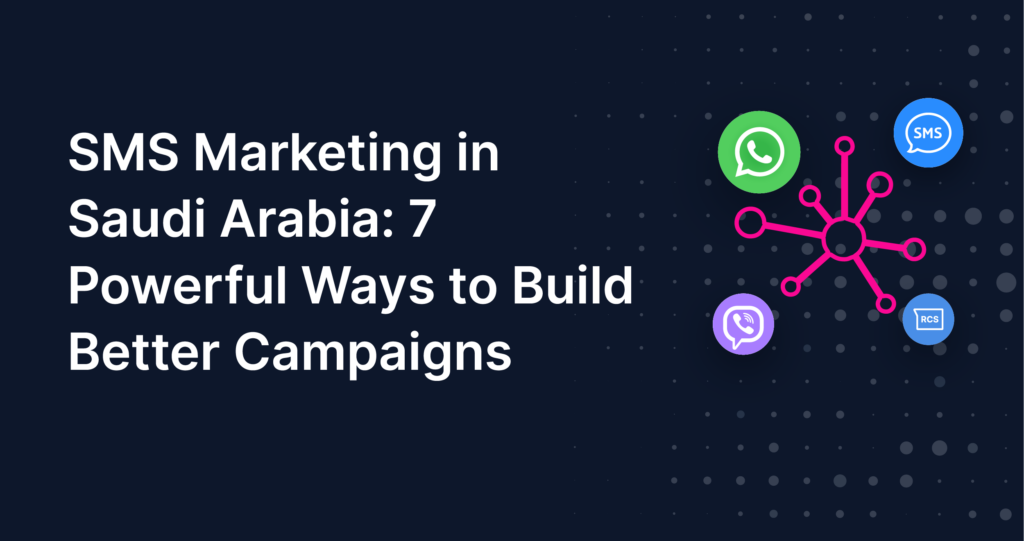
Javna’s broader CPaaS platform supports SMS, WhatsApp, Instagram messaging, campaigns, and connected communication tools. Within the campaign creator, Javna allows the business to select WhatsApp or SMS as the campaign channel.
This makes SMS part of a larger customer-engagement strategy rather than an isolated marketing tool. The strongest approach is not to send the same promotion through every available channel. Instead, give each channel a purpose.
How Javna Supports SMS Marketing
Javna provides the infrastructure and campaign capabilities businesses need to integrate SMS into customer communication.
The Javna CPaaS SMS API allows applications to send individual and bulk SMS messages using registered and approved sender names. Bulk SMS can support marketing campaigns and event announcements.
Messages can be scheduled for future delivery through supported API methods. Each SMS is assigned a unique identifier, helping businesses monitor its status.
Delivery statuses include Pending, Sent, Failed, Halted, Delivered, and Expired, with webhook-based status reporting available for connected systems.
Within the CPaaS environment, Javna also provides:
- Campaign creation and scheduling
- SMS and WhatsApp campaign-channel selection
- Address Book contact management
- Contact groups
- Custom contact attributes
- Message logs
- Campaign performance tracking
- Campaign failure investigation
This creates a simple campaign model:
Audience
↓
Segmentation
↓
Campaign
↓
SMS Sender ID
↓
Scheduled or immediate delivery
↓
Message status
↓
Performance review
For Saudi businesses, this technology should sit inside a wider marketing process that also considers language, relevance, customer permission, regulatory requirements, campaign frequency, and customer experience. Javna provides the communication layer. The business provides the strategy.
Frequently Asked Questions
What is SMS marketing in Saudi Arabia?
SMS marketing is the use of text messaging to send promotional communications to appropriate customer audiences in Saudi Arabia. Campaigns may include offers, product announcements, events, discounts, and re-engagement messages. Businesses must also consider applicable Saudi telecommunications and anti-spam requirements.
Does Javna support bulk SMS campaigns?
Yes. Javna’s SMS API supports both individual and bulk SMS. Its documentation identifies bulk SMS as suitable for marketing campaigns, announcements, and large-recipient communications.
Can businesses schedule SMS campaigns with Javna?
Yes. Javna supports scheduled SMS messages through supported API methods, and its CPaaS campaign environment allows campaign delivery to be scheduled.
Does Javna support branded SMS Sender IDs?
Javna supports predefined, verified sender names, including company or brand names where configured and approved. Users must register the sender names they intend to use before sending outbound SMS.
Can Javna tell whether an SMS was delivered?
Javna provides SMS status information including Pending, Sent, Failed, Halted, Delivered, and Expired. Delivery reports can be supplied through configured webhooks.
Can Javna manage SMS customer lists?
Javna’s CPaaS Address Book allows businesses to add, edit, and delete contacts, organize contacts into groups, and assign custom attributes.
Should Saudi SMS campaigns be sent in Arabic or English?
There is no universal answer for every audience. Arabic is central to Saudi communication, while many customers also use English. Where businesses have reliable customer-language preferences, campaigns should be designed around those preferences rather than sending one language to everyone.
Who regulates SMS communication in Saudi Arabia?
The current regulator is the Communications, Space & Technology Commission, or CST. CST maintains regulations covering SMS services and the reduction of spam messages and calls.
Is Javna responsible for a customer’s compliance with Saudi SMS marketing rules?
Businesses remain responsible for ensuring their SMS activities comply with the regulations and requirements that apply to them. Javna provides communication technology such as SMS APIs, sender management, campaigns, scheduling, and reporting; it should not be treated as a replacement for regulatory or legal review.
Can businesses combine SMS with WhatsApp using Javna?
Yes. Javna supports both SMS and WhatsApp within its CPaaS environment, and its campaign tools allow marketers to build campaigns using either channel according to their customer-engagement strategy.
Conclusion
Successful SMS marketing in Saudi Arabia is not about sending the largest possible number of messages.
- It is about relevance.
- Send the message to the right audience.
- Use a language they understand.
- Keep the copy clear.
- Choose the timing carefully.
- Use an appropriate and approved sender identity.
- Give customers an obvious next step.
- And measure what happens after the campaign.
Saudi businesses also need to place regulatory responsibility at the center of their SMS strategy.
The regulator today is CST, not CITC, and businesses should work from current official Saudi requirements rather than relying only on older marketing articles or outdated regulatory references.
Javna provides the technology needed to make SMS marketing operational at scale: bulk messaging, SMS APIs, scheduled delivery, approved sender-name management, campaign tools, customer groups, custom attributes, message logs, delivery-status reporting, and webhooks.
Those capabilities make it easier to build and manage campaigns. But good technology still needs good marketing judgment.
The strongest SMS strategy can be summarized simply:
Respect the customer, understand the audience, send something relevant, and learn from every campaign.
Key Takeaways About SMS Marketing in Saudi Arabia
- Prioritize relevance over volume: SMS marketing performs best as a targeted customer communication channel, not an uncontrolled broadcasting tool.
- Design Arabic and English campaigns intentionally: Use reliable customer-language preferences where available and keep messages clear in each language.
- Segment before sending: Javna’s contact groups, custom attributes, campaign tools, and SMS API can support more organized audience strategies.
- Schedule and measure campaigns: Javna supports scheduled SMS delivery, message-status reporting, webhooks, and campaign performance management.
- Follow current Saudi requirements: CST is the current telecommunications regulator in Saudi Arabia and maintains regulations covering SMS services and spam communication.
- Use Javna as the SMS communication layer: Javna provides SMS APIs, bulk messaging, Sender IDs, scheduling, contact management, reporting, and campaign tools while the business remains responsible for its marketing strategy and applicable regulatory obligations.